
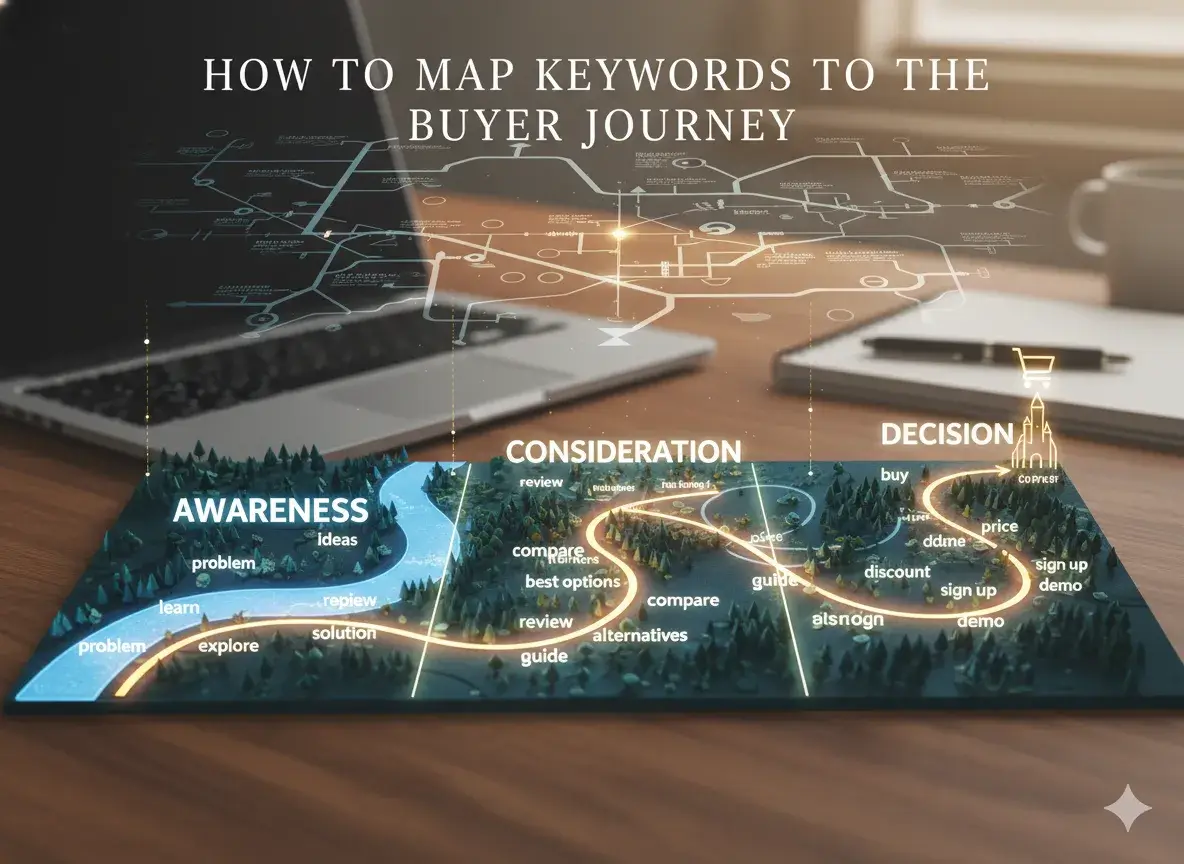
Quick Answer: Mapping keywords to the buyer journey means assigning every keyword you target to the specific stage a user is in when they search it. Stage 1 is awareness: the user is learning. Stage 2 is consideration: the user is comparing. Stage 3 is decision: the user is ready to act. When the keyword stage and the content type match, traffic converts. When they do not match, you get visitors who read everything and buy nothing. Most sites with a traffic-but-no-conversions problem are not producing bad content. They are producing the right content for the wrong stage.
Table of Contents
Start Here: You Have Probably Already Felt This Problem
You open Google Analytics. Organic traffic is up. Rankings are improving. Some pages are pulling in hundreds of visitors a week.
Then you check revenue. Or leads. Or contact form submissions.
Nothing moved.
This is the most disorienting experience in SEO because everything looks correct from the outside. The traffic is real. The rankings are real. The content is genuinely good. But the outcome is flat, and you cannot figure out why.
Here is what is actually happening.
Think about the last time you searched for something before making a purchase. You probably started with a broad question like “what is the best way to do X” or “how does Y work.” You were not ready to buy. You were learning. If someone had tried to sell you something at that exact moment, you would have ignored it or felt annoyed.
Then, a week later, you were searching “X tool vs Y tool” or “best X for my situation.” Now you were comparing. You were getting closer to a decision.
Then finally: “X pricing” or “sign up for X” or “X free trial.” Now you were ready. One click away.
Each of those three searches signals a completely different mental state. A completely different need. A completely different type of content that would have actually helped you.
That progression is the buyer journey. And the keywords people type at each stage are not random. They follow predictable patterns. Once you understand those patterns, you stop publishing content blindly and start building a system where every article does a specific job and hands the user to the next stage.
That is what this article covers, from the foundation to the architecture to the measurement. If you are new to SEO and keywords, read what keywords actually are in SEO before continuing. If you are past that, everything you need is below.
The Core Problem: Stage Mismatch
Most SEO strategies fail at conversions not because the content is bad but because the content is misaligned to the stage.
Stage mismatch happens when you publish content designed for one buyer stage but optimized for keywords that signal a different stage. The most common version: a transactional product page targeting informational keywords. The second most common version: an awareness blog post with a hard conversion CTA pushed at users who are not ready for it.
I have audited sites where 91% of their organic traffic was arriving through awareness-stage content while 0% of their decision-stage pages were indexed properly. The site had real traffic. It had genuinely useful content. It had zero conversion path. Every user who arrived and finished reading had nowhere to go except back to Google, where they found a competitor’s comparison page, read that, and converted there.
That is the full picture of stage mismatch. You built the trust. Your competitor collected the revenue.
The fix is not writing more content. The fix is understanding what stage each keyword belongs to, building the right content for that stage, and then connecting each stage to the next so users move forward inside your site instead of exiting to find what they need elsewhere.
Understanding what search intent actually means is the foundation this whole system sits on. If you are clear on intent, the rest of the mapping process becomes straightforward.
The Three Buyer Journey Stages: What They Are and How to Recognize Them
Stage 1: Awareness
Definition: The user has just discovered a problem or an opportunity. They do not yet know what solutions exist. They are building understanding from zero.
What this looks like in practice: Someone’s blog has been live for eight months with no traffic. They type “why is my blog not getting traffic” into Google. They are not comparing tools. They are not evaluating agencies. They want to understand what is happening. That is awareness-stage intent.
The keyword signals that indicate awareness:
- “what is,” “what are,” “what does”
- “how does,” “how to understand,” “how to learn”
- “why is,” “why does,” “why am I”
- “explained,” “guide to,” “introduction to,” “for beginners”
- “tutorial,” “overview,” “definition of”
Real keyword examples for a keyword research product:
- “what is keyword research in SEO”
- “why is my blog not getting any traffic”
- “how does Google decide which pages to rank”
- “what is organic search traffic”
- “how do keywords work in SEO”
What your awareness content must do: Answer the question completely. Not mostly. Not 80%. Completely. The user who finishes your awareness article and still has questions they need to Google has been failed by your content. Complete answers create trust. Incomplete answers create departures.
What your awareness content must never do: Sell. A person at the awareness stage is not evaluating products. They are building understanding. Showing them a “Sign Up Now” CTA before you have fully explained the problem signals that you care more about their wallet than their question. They leave and do not return.
The actual conversion goal at awareness: A trust deposit, not a transaction. Be the most complete, most honest, most useful source they encounter during their learning phase. When they reach consideration stage two weeks later, they return to the source that gave them the clearest understanding. That source needs to be you.
The E-E-A-T requirement at awareness: This stage has the highest trust bar because you are building credibility from zero. Real examples from direct experience matter here. Author credentials matter here. The difference between awareness content written by someone who has actually done the work and awareness content assembled from other blog posts is usually visible within three paragraphs.
Stage 2: Consideration
Definition: The user has defined their problem. They know what category of solution they need. They are now evaluating specific options before making a decision.
What this looks like in practice: That same person who searched “why is my blog not getting traffic” now knows keyword research exists. They know tools exist. They type “best keyword research tools for small business” or “Ahrefs vs SEMrush which is better.” They are not learning anymore. They are deciding between options.
The keyword signals that indicate consideration:
- “best,” “top,” “recommended,” “leading”
- “vs,” “versus,” “compared to,” “comparison”
- “review,” “is it worth it,” “honest review,” “real review”
- “alternatives to,” “[product] for [specific use case]”
- “pros and cons,” “which is better for,” “should I use”
Real keyword examples for a keyword research product:
- “best keyword research tools for beginners 2026”
- “Ahrefs vs SEMrush which is better for small business”
- “Ubersuggest review is it worth paying for”
- “free vs paid keyword research tools comparison”
- “keyword research tool for ecommerce sites”
The observation most SEOs miss about consideration keywords: Consideration keywords often outconvert transactional keywords when the content is written honestly. The reason is straightforward. A person searching “Ahrefs vs SEMrush for small business” is not browsing. They are one clear comparison away from a decision. If your content gives them that clarity, they convert right there. The transactional keyword only captures people who have already decided. The consideration keyword can influence the decision itself.
The mistake that ends consideration content before it starts: Writing comparison pages where your product wins every category on every dimension. Users recognize this within seconds. The four signs of fake comparison content are: every winner is the same product, no trade-offs are acknowledged, competitor strengths are described vaguely while your product’s strengths are described specifically, and the “recommendation” appears before the comparison is complete. When users spot any of these, they close the tab and find a source that will actually help them choose. That source will get the conversion.
The honest standard for consideration content: If your product genuinely performs worse than a competitor for a specific use case, your consideration content should say so. That acknowledgment builds more trust and more long-term conversions than claiming universal superiority. A person who chose you because you were honest about trade-offs becomes a customer who stays. Knowing how to choose the right keywords for each page is what separates consideration content that converts from consideration content that gets traffic but hands it off to someone else.
Stage 3: Decision
Definition: The user has completed their evaluation. They have selected a category of solution and often a specific provider. They want to complete one specific action: purchase, sign up, download, or book.
What this looks like in practice: That same person has decided they want Ahrefs. They type “Ahrefs free trial” or “Ahrefs annual plan discount.” They are not researching. They have decided. The only thing left is to complete the action.
The keyword signals that indicate decision:
- “buy,” “purchase,” “order”
- “sign up,” “get started,” “start free trial”
- “pricing,” “plans,” “cost,” “how much does”
- “discount,” “coupon,” “promo code,” “deal”
- “[brand name] + [action word]”
- “download,” “install,” “activate”
Real keyword examples for a keyword research product:
- “sign up for Ahrefs free trial”
- “SEMrush pricing plans 2026”
- “Ahrefs annual subscription discount”
- “upgrade to Ahrefs Pro”
- “start Ahrefs free trial”
The insight most people miss about decision pages: Decision pages fail most often not because of what they say but because of what they interrupt. A user who reaches your decision page has already done your job for you. They researched. They compared. They chose. The only thing left to do is not ruin it. Yet most decision pages introduce educational content, explain product features in depth, or link out to awareness articles. All of that creates doubt in a mind that had finished deciding. It is the equivalent of a cashier asking “are you sure you want this?” right before completing the transaction.
What decision content must do: Remove friction. Answer the final-moment objections that kill conversions. The objections at the decision stage are not “what is this product” questions. They are: “Is this refundable if it does not work for me?” “How long does setup take?” “Is there a minimum contract?” “Can I cancel anytime?” Identify your three to five most common final-moment objections and address each one explicitly on your decision pages.
The Complete Buyer Journey Keyword Map
| Buyer Stage | Search Intent Type | Keyword Signals | Content Format | User’s Mental State | Conversion Goal |
|---|---|---|---|---|---|
| Awareness | Informational | “what is,” “how to,” “why,” “guide,” “explained” | Educational articles, explainers, tutorials | Building understanding from zero | Trust deposit, newsletter subscription |
| Consideration | Commercial Investigation | “best,” “vs,” “review,” “compare,” “alternatives” | Comparison articles, roundups, reviews | Evaluating specific options | Click to product page, free trial start |
| Decision | Transactional | “buy,” “sign up,” “pricing,” “free trial,” “discount” | Product pages, landing pages, pricing pages | Ready to complete a specific action | Purchase, signup, booking, download |
Every keyword your site targets fits into one row of this table. If you cannot confidently assign a keyword to a specific row, you have not yet understood what the person wants when they search it. Keyword clustering by intent is the process that makes this classification manageable when you are working with hundreds of keywords at once.
The Stage Mismatch Tax: What You Lose Every Month You Ignore This
Before the six strategies, you need to understand what stage mismatch is actually costing you. I call this the Stage Mismatch Tax.
Every month you run a content strategy without journey mapping, you are paying this tax in three ways.
Tax 1: Conversion loss at awareness. Every awareness article that gets traffic but has no path to consideration content is accumulating what I call Conversion Debt. The article worked. It attracted real people who have a real problem. But those people, when they are ready to compare solutions, cannot do that on your site. They leave. The trust you built transfers to whoever has the comparison content they need. That competitor converts the audience you educated.
Tax 2: Credibility loss at consideration. Every comparison page that reads like marketing rather than honest analysis loses the user the moment they notice. And they always notice. This tax is worse than Conversion Debt because you not only lose the user but you lose them with a negative impression. They remember the site that tried to manipulate their decision.
Tax 3: Friction loss at decision. Every decision page that adds information a ready buyer did not ask for is introducing hesitation at the exact moment when momentum is most important. Each unnecessary element on a decision page is a small tax on conversions. They compound.
If your site has been publishing content for more than six months without journey mapping, you are paying all three taxes simultaneously. The good news is that this tax is entirely reversible. It is a systems problem, not a content quality problem. A proper keyword audit run against buyer stages will show you exactly where you are paying each tax and what to fix first.
6 Proven Strategies to Build Your Keyword-Journey Map
Strategy 1: Audit Every Existing Keyword Against the Three Stages
Before targeting new keywords, understand what you already have.
For every piece of existing content, identify the primary keyword and categorize it by stage. Do this in a spreadsheet. Three columns: URL, primary keyword, stage (awareness / consideration / decision). Nothing else needed for the first pass.
What you will find in most cases: 70 to 80 percent awareness content, 15 to 20 percent consideration content, 5 percent or less decision content. This distribution is not random. It happens because informational awareness content is the easiest to write, the easiest to rank for, and the most frequently recommended in generic SEO guides. Sites drift toward it naturally without realizing they are building a funnel with a wide top and no bottom.
Document the distribution. Look at it as a percentage. If you are above 60 percent awareness, your site is educating people for your competitors to convert. That is not a traffic problem. It is a funnel architecture problem.
The audit also surfaces something else: pages that are targeting the wrong intent for their stage. A product page ranking for informational keywords. An awareness article ranking for comparison keywords. These misalignments create confusion for both users and search engines. Understanding keyword mapping at the page level shows you how to correct these assignments so every page serves a single clear intent.
Strategy 2: Treat Every Funnel Gap as a Competitor Handoff
A funnel gap is not a content gap. It is a competitor handoff.
Here is what actually happens when you have an awareness article with no downstream consideration content. A user finds your article. They learn from it. They trust you more than they did before they arrived. Then they are ready to compare tools. They search “best [tool category] for [their use case]” and your site has nothing. A competitor has that comparison article. The user clicks it. The competitor inherits all the trust you built. The competitor makes the conversion.
You funded the customer acquisition. Your competitor collected the revenue.
This reframe matters because “I need to fill a content gap” does not carry urgency. “I am handing qualified leads to my competitors with every article I publish without a downstream stage” carries urgency. After your audit, your funnel gaps are not low-priority backlog items. They are the highest-priority items on your entire content roadmap.
Use keyword gap analysis to see which consideration and decision keywords your competitors are ranking for that you are not. Those are not just gaps in your coverage. They are the exact handoff points where your awareness traffic is going after leaving your site.
Strategy 3: Build All Three Stages of a Topic Cluster Before Publishing Any of Them
For every important topic your site covers, generate keywords at all three stages before you write a single word.
Generating awareness keywords for a topic: What would someone search the first time they realized this problem exists? What are the foundational questions someone completely new would ask? What are the “I do not even know what I do not know yet” searches?
Generating consideration keywords for a topic: What comparisons, reviews, or “best of” queries would someone run when actively evaluating solutions? What use-case-specific comparisons matter to your specific audience? What are people asking in subreddits, forums, and community spaces in your niche?
Generating decision keywords for a topic: What action-oriented phrases would a ready buyer search? What branded plus action word combinations should you appear for? What pricing, trial, or discount queries are people running?
For applying selection criteria to these keywords, including volume thresholds, difficulty ranges, and SERP intent confirmation, using Google Search Console for keyword research gives you data on what real searches are already sending users to your existing pages, which is where the strongest opportunities tend to hide.
The rule that changes everything: build all three stages of a topic cluster before any of them go live. Publish them together. The moment an awareness article is live, users start arriving. If there is no consideration content to send them to, you immediately begin paying the Conversion Debt. Publish a complete cluster and the user journey works from the first day.
Within each stage, also map the long-tail variations. Long-tail keywords within the buyer journey framework are not just lower-competition options. They are often the highest-converting searches in each stage. “Best keyword research tool for ecommerce product pages under 10 keywords per month” is a long-tail consideration keyword with extremely specific intent. The person typing that is not browsing. They convert at rates that short-tail equivalents rarely match.
Strategy 4: One Primary Keyword per Stage per Topic, Assigned Before Writing Begins
For each topic area, select the single strongest keyword candidate at each buyer stage. Assign it to a specific page. Document the assignment before any content is written.
This discipline prevents two problems that silently destroy content strategies.
The first problem is what I call the “build awareness now, add the rest later” trap. The awareness article gets written and ranked. Consideration and decision content goes on the backlog. Months pass. The awareness article is generating real traffic. The consideration and decision content still does not exist. The site has been paying Conversion Debt for six months and no one noticed because the traffic numbers look fine.
The second problem is keyword cannibalization. When you build topic clusters without pre-assigning keywords, you end up with two awareness articles targeting nearly identical intent, splitting traffic and confusing search engines about which page to rank. The buyer journey framework prevents this naturally: one intent, one stage, one page.
Assign first. Write second. This single change in sequence eliminates both problems entirely.
Strategy 5: Write the Conversion Goal Into Every Content Brief Before Writing Starts
Every piece of content needs a defined conversion goal established before a single word is written. The goal is different for each stage.
Awareness content conversion goal: The user subscribes to a newsletter, bookmarks the page, or clicks to a related consideration article. Not a product click. Not a purchase. A sustained relationship with a person who is not yet ready to buy. The CTA on an awareness article should say something like “Ready to compare your options? Here is how to choose the right tool for your situation.” That is a forward movement. That keeps the user inside your site and moves them toward consideration.
Consideration content conversion goal: The user clicks to a product page, starts a free trial, requests a demo, or submits a contact form. This is where middle-of-funnel conversion events happen. The CTA here is direct and specific: “See pricing,” “Start free trial,” “Compare plans.” Not “Learn more” (that sends them backward). Not “Contact us” without context (that adds friction). A clear, specific, stage-appropriate forward action.
Decision content conversion goal: The user completes the primary action: purchase, signup, booking, download. One CTA. One objective. No links back to educational content. No distractions. Every element on the page exists to support this one outcome or to remove a final-moment objection that might prevent it. If your site gets traffic but produces no sales, your decision-stage content is either missing, unclear, or cluttered with awareness-level information that creates hesitation at the wrong moment.
Strategy 6: Build Internal Links That Move Users Forward Through the Journey
Internal links are not a technical SEO box to check. They are the physical mechanism that connects each stage of your buyer journey to the next.
Without deliberate internal linking, a user who finishes your awareness article has nowhere to go. They read everything. They trust you. Then the page ends and there is nothing forward. That is not a design problem. It is a revenue architecture problem.
The journey-direction linking principle: every awareness page links to at least one relevant consideration page. Every consideration page links to the most relevant decision page. The direction is always forward. Never backward. Never sideways into unrelated topics.
The implementation for every article you write:
- Identify which buyer stage this content serves.
- Identify the next logical stage for a user who benefited from this content.
- Identify the specific page on your site that serves that next stage for this topic.
- Find the most natural place in the current content to place that link.
- Write anchor text that describes where the user is going, not just what the destination page is called.
This takes three to four minutes per article. Done consistently across a full content library, it transforms disconnected pages into a functional conversion system. Increasing organic keyword coverage without backlinks is built significantly on this kind of internal architecture because strong internal linking reinforces topical authority signals that search engines use to assess how comprehensively a site covers a subject.
The Dead Funnel: Why Strong Traffic Can Look Like SEO Success While Revenue Stays Flat
There is a specific failure pattern in SEO that is so common it deserves its own name. I call it the Dead Funnel.
A Dead Funnel has strong top-of-funnel awareness content and nearly nothing below it. Traffic is growing. Rankings are improving. The site owner believes the SEO is working. Revenue is flat. The disconnect is invisible from the traffic dashboard.
What is happening inside a Dead Funnel: The site is attracting the right audience at the wrong moment and then providing no path forward when those users are ready to act. The users are not bad leads. Their interest is genuine. The site just never built the infrastructure to capture them when their intent shifted from learning to comparing to buying.
How to diagnose a Dead Funnel in your own site:
Step 1: Export all your organic landing pages from Google Search Console.
Step 2: Assign each page to a buyer stage based on its primary keyword.
Step 3: Calculate the percentage of organic sessions entering through each stage.
Step 4: Calculate the conversion rate from sessions in each stage.
If more than 60 percent of your organic sessions arrive through awareness content and your consideration and decision content accounts for less than 20 percent of sessions, you have a Dead Funnel. The fix is never writing more awareness content. The fix is building the consideration and decision layers your existing traffic is currently leaving your site to find.
Sites that have good content but still get no meaningful results are often running a Dead Funnel without realizing it. The content is genuinely useful. The problem is architectural, not qualitative.
How to Handle Keywords That Do Not Fit Neatly Into One Stage
Not every keyword is clean. Some searches sit between stages or carry mixed intent. Here is how to handle the most common edge cases.
Mixed-intent keywords: A search like “how much does Ahrefs cost” is technically an informational question but carries clear decision-adjacent intent. The user is not curious about pricing as an academic matter. They are evaluating whether the price fits their budget before committing. Check the SERP. If Google is ranking pricing pages and landing pages for the query, build decision content. If it is ranking educational cost-breakdown articles, build awareness-leaning content that is still forward-looking toward the decision.
Trending keywords that are new to the market: New trends still belong to stages. “AI keyword research tools 2026” is a consideration keyword that happens to be current. Map it to consideration, build the right format for that stage, and publish before the search volume peaks. The framework does not change with trends. Only the timing does.
Keywords where you cannot beat the SERP with a standard approach: Some consideration keywords are dominated by established review platforms with hundreds of user reviews. In these cases, the angle shifts. Build comparison content around a perspective those platforms cannot offer: your direct testing experience, a specific use case they have not covered, or a niche audience they are not writing for. Keyword difficulty metrics tell you how hard it is to rank, but they do not tell you which angle gives you a realistic path to ranking. That requires reading the top ten results carefully and finding the genuine gap.
Brand-adjacent keywords at the decision stage: If you are not building content for “[your brand] + pricing,” “[your brand] + free trial,” and “[your brand] + review,” you are leaving your own decision traffic to third parties. Someone who searches your brand name with a transactional modifier has already decided they want you. They are just trying to find the path to complete the action. Own these keywords completely.
How AI Search Changes Keyword-Journey Mapping in 2026
Google’s AI Overviews, Perplexity, ChatGPT, and similar systems have introduced a dimension that traditional keyword-stage mapping did not need to account for: retrieval optimization.
These systems do not rank pages. They extract passages. The specific paragraph from your awareness article that most clearly answers “what is commercial investigation intent” may appear in an AI Overview whether or not the user ever clicks your link. This creates a different kind of visibility, and it rewards a different kind of content structure.
Awareness content and AI retrieval: Place the direct answer in the first two sentences after every heading. Write declarative statements with no hedging: “Awareness-stage keywords are informational queries from users who are discovering a problem for the first time.” AI systems extract passages that stand alone without requiring surrounding context. A passage that only makes sense in the context of the full article will not be extracted. A passage that answers a complete question in two to three sentences will be. Answer engine optimization techniques covers the full structural methodology for this.
Consideration content and AI retrieval: Comparison tables, named frameworks, and structured pros and cons lists are highly extractable. When you build “Ahrefs vs SEMrush for small business” content, include a summary table that answers the comparison question directly. Perplexity and similar systems actively pull comparison data from structured formats when they are clearly labeled and free of marketing language.
Decision content and AI retrieval: Decision pages need to answer final-moment objections in quotable, extractable language. “Ahrefs offers a 7-day trial at seven dollars. You can cancel anytime from your account settings. No minimum contract applies.” That is extractable. “We have flexible options designed to meet your needs” is not extractable because it says nothing specific.
The buyer stage of your content directly affects which AI systems will extract it and for which types of queries they will surface it. Building retrieval-optimized structure into each stage is no longer optional for sites that want visibility in AI-driven search environments. How to get featured snippets on Google uses the same structural logic because featured snippets and AI extraction both reward the same property: complete, specific, standalone answers.
How to Measure Keyword Performance Correctly at Each Stage
Applying the same metrics across all three buyer stages produces false conclusions. Awareness content that does not generate direct sales is not failing. Decision content with low traffic volume is not underperforming. The stage determines which metrics are relevant.
Awareness stage: measure discovery and trust signals
- Organic impressions growth over 90-day periods
- Time on page and scroll depth (are users reading fully or bouncing early?)
- Email subscription rate from organic traffic
- Return visit rate: users who came back without a direct search
- Branded search volume growth over time (the single strongest signal that awareness is building real trust)
Consideration stage: measure evaluation progress
- Click-through rate from consideration pages to decision pages
- Free trial initiations and demo requests attributed to organic consideration content
- Contact form submissions with qualifying context
- Session depth from users who entered through consideration content
- Time on comparison tables and structured comparison sections specifically
Decision stage: measure completion and friction
- Conversion rate from organic traffic to primary action
- Revenue or lead value attributed to organic decision content
- Specific drop-off points in the path from decision content to conversion completion
- Common final-moment objections appearing in support tickets, chat logs, or sales calls
Tracking keyword rankings accurately is the baseline. Without knowing which keywords drive which traffic to which pages, you cannot attribute conversions to their originating stage. The measurement framework only works if the keyword-to-page assignment is clean and documented.
The critical insight on measurement: a successful awareness article that sends 40 percent of its traffic to your consideration content is outperforming a consideration article with a 2 percent direct conversion rate if your average customer value is high enough. Stage metrics are only meaningful when you understand the revenue contribution of each stage in sequence, not in isolation.
Topical Authority and the Buyer Journey: How They Reinforce Each Other
There is a compounding relationship between buyer journey coverage and topical authority that most SEOs understand conceptually but few execute on correctly.
When you cover a topic at all three buyer stages, you are not just building a conversion funnel. You are demonstrating to search engines that your site understands this topic comprehensively. An awareness article, a consideration article, and a decision page on the same topic, properly interlinked and semantically coherent, signal topical authority more strongly than five disconnected awareness articles on loosely related subjects.
This is why journey-mapped topic clusters compound over time while keyword-volume-chasing strategies plateau.
The practical implication: when you are deciding whether to write your sixth awareness article on keyword research or your first consideration article comparing keyword research tools, the consideration article almost always wins on both the conversion dimension and the topical authority dimension. It fills a funnel gap, generates conversion-stage traffic, and strengthens the semantic cluster around the topic in a way the sixth awareness article cannot.
Building topical authority through interconnected content is the long-term compounding engine that journey mapping accelerates. Every new stage you add to a cluster strengthens every other stage in that cluster.
The E-E-A-T Layer: How Experience Shows Differently at Each Stage
Google’s E-E-A-T requirements (Experience, Expertise, Authoritativeness, Trustworthiness) are not uniform across buyer stages. They apply differently depending on what the user needs from the content.
E-E-A-T at awareness: The experience signal here is showing that you have actually encountered the problem you are explaining. Not just read about it. Phrases like “when I first started auditing sites for this issue” or “the pattern I see most often when clients come to me with this problem” are not filler. They are trust-building evidence that the person explaining this has direct exposure to it.
E-E-A-T at consideration: The experience signal at the consideration stage is hands-on product testing. If your comparison article says “we tested both tools across 50 websites over three months,” that is a different level of authority than “according to their feature pages, Ahrefs offers X while SEMrush offers Y.” Users and search engines can distinguish these. The E-E-A-T SEO guide covers how to build demonstrable experience signals into content at a structural level.
E-E-A-T at decision: The experience signal at the decision stage is specificity. Vague decision pages feel like they were written by someone who has never actually used the product. Specific decision pages, especially ones that address the exact friction points real customers experience, feel like they were written by someone who has been inside the product and inside the support queue. That specificity is what makes decision content trustworthy enough to actually convert.
Frequently Asked Questions
What is keyword-to-buyer-journey mapping?
Keyword-to-buyer-journey mapping is the practice of assigning every keyword you target to the specific stage a user is in when they search it. Stage 1 is awareness: the user is learning about a problem. Stage 2 is consideration: the user is comparing solutions. Stage 3 is decision: the user is ready to act. Each stage has a different search intent, different keyword vocabulary, different content format, and different conversion goal. Mapping keywords to stages before creating content turns a content library into a conversion system rather than a traffic accumulator.
Which buyer journey stage should I build first?
Build based on where your current gap is most costly. If you have no existing content, build consideration and decision content first. These stages are closest to revenue. Adding awareness content to an existing site that already has consideration and decision coverage builds a sustainable top-of-funnel. Adding awareness content to a site with no bottom-of-funnel creates Conversion Debt from day one.
How do I know which stage a keyword belongs to?
Read the signal words and confirm with the SERP. Informational signal words (what, how, why, guide, explained) indicate awareness. Commercial investigation signal words (best, vs, review, compare, alternatives) indicate consideration. Transactional signal words (buy, sign up, pricing, free trial, discount) indicate decision. When signal words are ambiguous, search the keyword yourself and study what type of content Google is ranking. The SERP reflects real user intent patterns at scale and is always more reliable than intuition.
Can one page target multiple buyer stages?
In most competitive niches, no. A page trying to serve awareness and consideration simultaneously splits its relevance signal for both intents and serves neither well. There are genuine exceptions: a comprehensive pillar page in a very low-competition niche may cover multiple stages effectively. But for any topic where multiple sites are competing seriously, one page, one stage, one primary intent consistently outperforms consolidated approaches in both rankings and conversions.
Why do I get good traffic but no conversions?
The most common diagnosis is a Dead Funnel: strong awareness content attracting early-stage users with no consideration or decision content to move them forward. They learn from your site, move to a competitor’s site to compare options, and convert there. The diagnostic check: calculate your organic session distribution by buyer stage. If more than 60 percent of your organic traffic is landing on awareness content and you have less than 20 percent landing on consideration and decision content, you have a Dead Funnel. The fix is not writing more awareness content.
How does this framework apply to ecommerce specifically?
Ecommerce sites typically need a heavier emphasis on consideration and decision content than B2B or SaaS sites. The awareness stage still matters for building organic discovery, but the revenue-generating stages are category comparison pages (consideration) and product and collection pages (decision). Most ecommerce sites underinvest in honest consideration content and then wonder why product pages underperform despite strong traffic. The consideration content is doing the pre-qualifying work that makes the decision page convert. If that pre-qualifying layer is missing or dishonest, the decision page never gets a properly prepared buyer. Technical SEO for ecommerce covers the structural requirements that make both layers of this work correctly from an indexation and crawlability standpoint.
How many keywords should I target at each stage?
The minimum viable cluster is one strong awareness article, one strong consideration article, and one strong decision page per major topic. Distribution beyond that depends on your business model and competitive landscape. For most B2B and SaaS sites, roughly 50 percent awareness, 30 percent consideration, and 20 percent decision works as a sustainable long-term ratio. For ecommerce, skew heavier toward consideration and decision. The ratio that matters most is not the total count but the conversion path: for every awareness article, is there a consideration page it naturally leads to? For every consideration page, is there a decision page it naturally converts toward?
Key Takeaways
Keyword mapping is the difference between a traffic strategy and a conversion system. Traffic without stage alignment is an audience you cannot sell to. You can measure it. You can report it. You cannot monetize it.
Every funnel gap is a competitor handoff. When your awareness content has no downstream consideration layer, every user who finishes your article and searches for a comparison is going to whoever built that comparison content. You funded their customer acquisition.
The Dead Funnel is the most common invisible failure in SEO. Sites running a Dead Funnel look successful on traffic dashboards and fail on revenue dashboards. The diagnosis is simple. The audit by stage reveals it in 20 minutes.
Decision pages fail because of what they interrupt, not because of what they say. The user who reaches your decision page has already decided. The only remaining job is not to introduce doubt. Educational content on a decision page is doubt.
Measure by stage, not by universal metrics. Awareness content evaluated by conversion rate will look like failure. Decision content evaluated by traffic volume will look like failure. The wrong metrics applied to any stage produce conclusions that make you cut what is working.
Build all three stages before publishing any of them. The moment an awareness article is live, users arrive. If the consideration and decision layers do not exist yet, you begin paying Conversion Debt immediately. Publish a complete cluster and the user journey works from the first visitor.
Build the complete keyword strategy with these:
- What Are Keywords in SEO
- Keyword Research for Beginners
- How to Choose Keywords for SEO
- Keyword Research Strategy
- Keyword Mapping for SEO
- Keyword Gap Analysis
- Keyword Clustering
- What Is Search Intent in SEO
- Short-Tail vs Long-Tail Keywords
- Keyword Difficulty Explained
- How to Track Keyword Rankings
- Topical Authority in SEO
- E-E-A-T SEO Guide
- Answer Engine Optimization Techniques
- On-Page SEO Checklist
- How to Write SEO-Friendly Content
- How to Get Featured Snippets on Google
- Keyword Audit SEO Checklist
- How to Increase Organic Keywords Without Backlinks
- Website Traffic But No Sales