
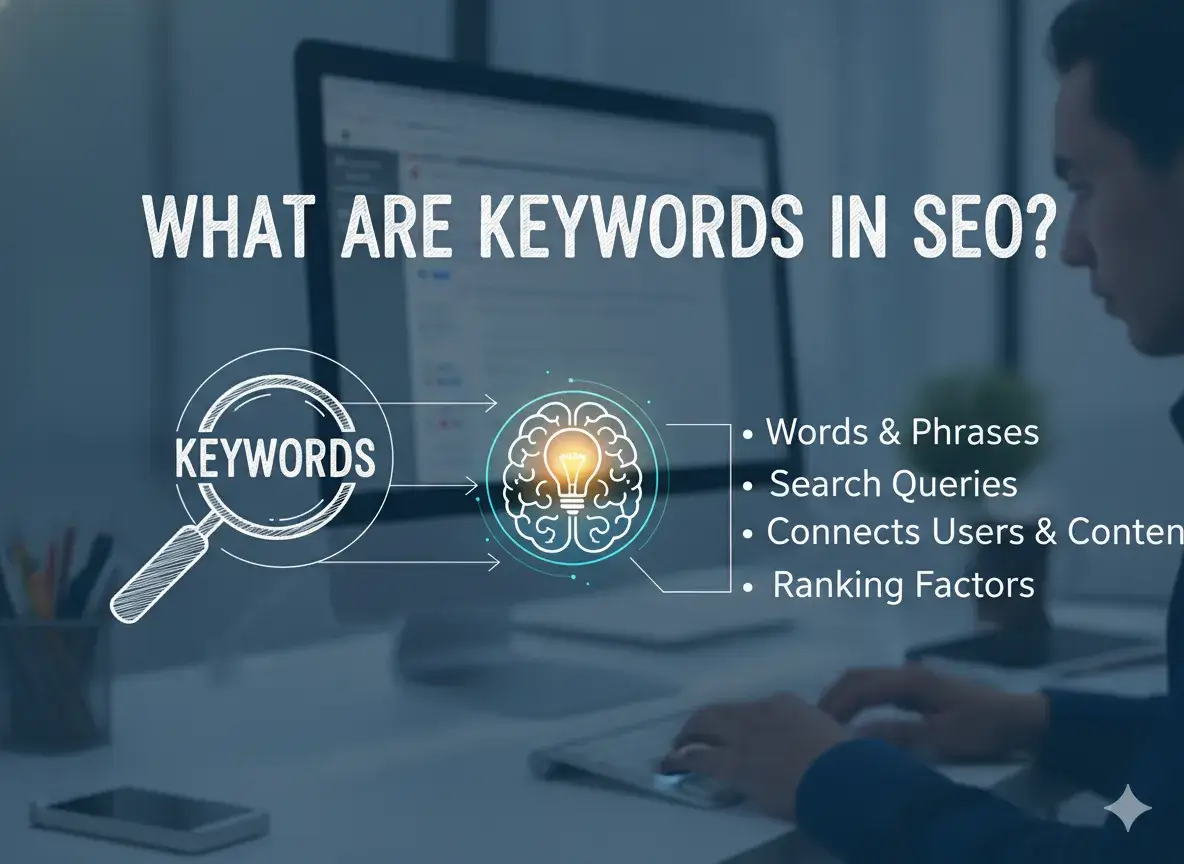
Quick Answer: Keywords in SEO are the phrases people type into search engines to find information, products, or services. Each keyword represents a specific user intent at a specific moment. There are 7 keyword types: short-tail, long-tail, informational, commercial investigation, transactional, navigational, and local. Each type demands a different content format to rank.
Table of Contents
What Are Keywords in SEO? The Real Definition
Most guides define keywords as “words people type into search engines.” That definition is technically accurate and practically useless.
Here is the definition that actually changes how you make content decisions:
A keyword in SEO is the linguistic expression of a user’s intent at a specific moment in time.
When someone types “how to fix a leaking kitchen faucet,” they are not searching for words. They are standing in their kitchen, frustrated, and they need practical help right now. The keyword is the surface layer. Beneath it is a complete human context: an emotion, an urgency, a situation, and a desired outcome.
This distinction matters for one specific reason. When you understand that keywords represent intent rather than just language, you stop optimizing for phrases and start optimizing for people. That shift separates content that ranks from content that ranks and actually converts.
In technical terms, a keyword in SEO is any word or phrase a search engine uses to match a user’s query to a relevant webpage. When Google’s algorithm crawls your page, it extracts topics, entities, and concepts your content covers. It then compares those against what users are searching for. Keywords are how you communicate to the algorithm what your page is about and who it should be shown to.
Keywords vs. Search Queries: A Critical Distinction
These two terms are used interchangeably in casual conversation. Understanding the difference gives you a more precise and actionable mental model.
A search query is the exact phrase a user types into a search engine. It is raw and unfiltered. It may include typos, conversational phrasing, or unusual word order. It is what the user actually typed.
An SEO keyword is a phrase you deliberately target in your content strategy. It is refined, researched, and selected based on volume, difficulty, and intent. It represents a pattern across thousands of slightly different queries, not one exact phrase.
One keyword can capture traffic from hundreds of semantically related queries. When Google’s AI Overview cites your content or a Featured Snippet surfaces your paragraph, it happens because your keyword targeting aligned with the broader intent behind many query variations. Not just the one phrase you optimized for.
Understanding this relationship is foundational. For the complete keyword selection system that builds on it, read How to Choose Keywords for SEO: The Only Complete System You Will Ever Need in 2026.
The 7 Keyword Types in SEO – With Real Examples
Understanding keyword types is not academic. Each type maps to a different user mindset, a different point in the decision journey, and a different content format that Google rewards. Targeting the right type for the right page is as important as the keyword itself.
1. Short-Tail Keywords (Head Terms)
Short-tail keywords are one to two word phrases representing broad topics.
Examples: “SEO,” “shoes,” “keyword research,” “email marketing”
Defining characteristics:
- Monthly volume often in the tens of thousands to hundreds of thousands
- Keyword difficulty typically above 70
- Intent is almost always ambiguous. Someone searching “SEO” might want a definition, a tool, a course, or a job
When to use them: Short-tail keywords work for your broadest brand or hub pages. They are not appropriate targets for specific articles on sites without very high domain authority. New and mid-authority sites should treat these as long-term aspirational targets, not starting points.
2. Long-Tail Keywords
Long-tail keywords are three or more words, more specific, lower in volume, and dramatically more actionable.
Examples: “how to do keyword research for a local restaurant website,” “email marketing strategy for Shopify stores under 10,000 subscribers”
Defining characteristics:
- Monthly volume typically 50 to 2,000
- Keyword difficulty typically below 30
- Intent is highly specific. The user has told you who they are, what they need, and what constraints they are working within
The strategic case: For any site with a domain rating below 40, long-tail keywords are the most reliable path to page-one rankings within a realistic timeline. They convert better, rank faster, and are accessible without years of domain authority building.
For the full strategic comparison of short-tail vs long-tail and when to use each, read Short-Tail vs Long-Tail Keywords: 5 Brutal Truths Every SEO Needs to Know in 2026.
3. Informational Keywords
The user wants to learn something. They are building understanding. They are not ready to buy.
Signal words: “what is,” “how to,” “why does,” “guide,” “tutorial,” “explained,” “definition”
Examples:
- “what is domain authority in SEO”
- “how does Google crawl a website”
- “why is my website not getting traffic”
Content format Google rewards: Blog posts, long-form guides, explainer articles, educational videos.
Conversion strategy: The goal at this stage is not conversion. It is trust. Users at the informational stage are building knowledge. Serve them genuinely useful information and they return when they are ready to decide.
4. Commercial Investigation Keywords
The user is evaluating options before making a decision. They know they need something. They have not decided what yet.
Signal words: “best,” “vs,” “review,” “compare,” “top,” “alternatives,” “is [product] worth it”
Examples:
- “Ahrefs vs SEMrush for small business”
- “best keyword research tools for beginners 2026”
- “Ubersuggest review is it worth the money”
Content format Google rewards: Comparison articles, review roundups, detailed product evaluations, use-case-specific guides.
Why these convert exceptionally well: The user is one decision away from taking action. A genuinely helpful, honest comparison that gives them the clarity they need converts at a far higher rate than either informational or transactional content targeting the same subject.
5. Transactional Keywords
The user is ready to act. The decision is made or nearly made.
Signal words: “buy,” “download,” “sign up,” “get,” “order,” “free trial,” brand name combined with action words
Examples:
- “sign up for Ahrefs free trial”
- “buy SEMrush annual plan”
- “download Google Analytics for WordPress”
Content format Google rewards: Product pages, pricing pages, landing pages, sign-up flows.
Content goal: Remove friction. Answer last-moment objections. Make the action obvious and easy to complete. The user does not want education here. They want confirmation and a clear path forward.
6. Navigational Keywords
The user wants to reach a specific destination. They know exactly where they are going.
Signal words: Brand names, product names, specific website names, “login,” “official site,” “contact,” “homepage”
Examples:
- “Gmail login”
- “Ahrefs free trial”
- “Google Search Console official”
Why you should not target these: Unless you are that brand, you have virtually zero chance of ranking. The user has a specific destination in mind. Your page is not it. Targeting navigational keywords for other brands wastes content creation effort.
7. Local Keywords
The user is looking for something geographically specific.
Signal words: City names, “near me,” “in [location],” neighborhood names, region-specific terms
Examples:
- “SEO consultant in Bangalore”
- “keyword research agency near me”
- “digital marketing services in Pune”
What local keywords require: Location-specific content, a verified Google Business Profile, and local citation consistency. Local SEO is a distinct discipline from organic SEO. These keywords are essential for any business serving a defined geographic area.
Why Keyword Type Determines Your Content Format
This is the insight most SEO articles skip. It is also where the most content creation effort gets permanently wasted.
Google does not rank pages. It ranks the best answer to a specific type of query. The format of the best answer is determined by keyword type.
When a user submits an informational keyword, Google expects an article or guide. When they submit a transactional keyword, Google expects a product or service page. When they submit a commercial investigation keyword, Google expects a comparison or review.
If you write a product page targeting an informational keyword, you will not rank. The algorithm has already determined what format best serves that query. Your page speaks the wrong language regardless of its optimization.
The rule: always identify keyword type before deciding what kind of content to create. This single practice prevents the most common and most expensive content marketing mistake: producing the right content for the wrong intent.
| Keyword Type | Required Content Format | Primary Goal |
||||
| Informational | Guides, explainers, tutorials | Build trust through genuine usefulness |
| Commercial Investigation | Comparisons, reviews, roundups | Help user make an informed decision |
| Transactional | Product pages, landing pages | Remove friction and enable action |
| Navigational | Not worth targeting for most sites | N/A |
| Local | Location pages, local guides | Drive geographic-specific inquiries |
| Short-tail | Hub pages, pillar content | Establish broad topical authority |
| Long-tail | Focused guides, step-by-step content | Serve specific needs with exact answers |
The 3 Filters That Decide If a Keyword Is Worth Targeting
Not every keyword deserves your time. Three criteria determine whether a keyword represents a genuine opportunity or a trap that wastes months of effort.
Filter 1 – Search Volume: Is there real demand? A keyword no one searches generates zero traffic regardless of ranking position. The volume threshold varies by niche. B2B software keywords at 80 searches per month can be extremely valuable. Consumer lifestyle keywords at 80 searches per month are usually not worth the effort.
Filter 2 – Keyword Difficulty: Can you realistically rank given your current domain authority? A keyword dominated by sites with 10 years of authority and thousands of backlinks is not a realistic opportunity for a site at domain rating 15 to 25. The difficulty threshold that is achievable depends entirely on your site’s current authority level.
Filter 3 – Intent Alignment: Does the traffic this keyword generates serve your actual goal? Traffic that has no reason to care about what your site offers is not valuable traffic. It inflates impression counts and produces zero business outcomes.
All three must pass. A keyword failing even one filter is not a partial opportunity. It is a trap with one attractive quality.
How Keywords Work in AI Search and Voice in 2026
The keyword landscape in 2026 is meaningfully different from 2020. Understanding what changed prevents optimizing for a model that no longer reflects reality.
Google AI Overviews and Perplexity pull answers from pages that clearly and directly address the dominant intent behind a query. Pages structured with clear headings, direct answers in the first paragraph, and comprehensive coverage of the topic’s full question landscape are consistently more likely to be cited. The keyword is still the entry point. But the content that gets cited earns that citation through topical depth and direct answer quality, not keyword density.
Voice search is structurally long-tail. When someone asks a voice assistant a question, they speak in natural, conversational sentences that map to long-tail phrases. “What is the best free keyword research tool for a new website with no budget” is a voice query that corresponds directly to a long-tail keyword. Content optimized for long-tail phrases captures both traditional search traffic and voice query traffic simultaneously.
Microsoft Bing in 2026 integrates heavily with Microsoft Copilot and other AI surfaces. Bing rewards content that demonstrates genuine expertise, provides direct answers, and is structured for easy AI extraction. The E-E-A-T signals that matter for Google also matter for Bing, making the investment in demonstrating expertise beneficial across all major search surfaces.
Semantic SEO: Why Related Keywords Matter More Than Repetition
Google’s algorithm identifies entities (people, places, tools, concepts) and the semantic relationships between them within your content. This is how it evaluates topical relevance at a level far beyond counting keyword occurrences.
A guide about keyword research that naturally mentions Google Search Console, Ahrefs, domain authority, search intent, keyword difficulty, long-tail keywords, and SERP analysis as related concepts builds a semantic entity map. That map reinforces the page’s topical relevance for dozens of related queries the author never explicitly targeted.
The practical implication: Write for complete topical coverage. Ask what concepts, tools, people, and processes are genuinely related to your topic. Include them naturally because they belong in a complete treatment of the subject. A page that covers a topic with genuine breadth and depth accumulates rankings for related queries over time. This is not an accident. It is semantic SEO working as designed.
What this means for keyword strategy: Secondary and related keywords matter as much as your primary keyword. Topical authority matters more than individual keyword placement. A website that comprehensively covers keyword research will rank for more keyword research queries than a website that has optimized individual pages perfectly but lacks topical depth.
To understand how topical authority is built through deliberate content architecture, read Topical Authority SEO: 5 Proven Ways Keywords Build Unshakeable Dominance in 2026.
Frequently Asked Questions
What are keywords in SEO?
Keywords in SEO are the phrases users type into search engines when looking for information, products, or services. Each keyword represents a specific user intent. There are 7 keyword types: short-tail, long-tail, informational, commercial investigation, transactional, navigational, and local. Each type demands a different content format to rank effectively.
What is the difference between a keyword and a search query?
A search query is the exact phrase a user types into a search engine at a specific moment. A keyword is a phrase strategically targeted in your content, representing a pattern across hundreds or thousands of related queries. One keyword can capture traffic from many different but semantically related search queries.
How many types of keywords are there in SEO?
There are 7 main keyword types in SEO: short-tail (head terms), long-tail, informational, commercial investigation, transactional, navigational, and local. Each type corresponds to a different user mindset, funnel stage, and content format requirement.
Why do keywords matter for SEO?
Keywords matter because they are how search engines match your content to the users who need it. Without deliberate keyword selection, content reaches no audience regardless of its quality. With correct keyword selection, content reaches exactly the right users at the exact moment they need what your page offers.
What makes a keyword good or bad for SEO?
A keyword is good for SEO when it passes three filters simultaneously: it has sufficient search volume to justify content creation, it has a difficulty level your site’s domain authority can realistically compete for, and its search intent aligns with what your page delivers. A keyword failing any one of these three filters is a poor target regardless of how attractive it looks on the remaining two.
How have keywords changed in 2026?
In 2026, keyword strategy has shifted from targeting individual phrases to building topical authority through comprehensive content coverage. Google and Bing now evaluate semantic entity relationships, topical depth, and E-E-A-T signals alongside keyword presence. Content that covers a topic completely from multiple angles consistently outranks content that repeats a target phrase frequently but covers the topic shallowly.
Key Takeaways
Keywords in SEO are expressions of user intent, not just phrases to target mechanically. The human need behind the search query is what your content must serve.
The 7 keyword types each map to a specific content format. Mismatching keyword type with content format is the most common reason well-written content fails to rank.
All 3 filters must pass simultaneously. Volume, keyword difficulty, and intent alignment are not optional checks. A keyword failing one is a trap, not an opportunity.
Semantic SEO rewards topical coverage over keyword density. Write for complete, genuine coverage of your subject. Secondary keywords appear naturally when depth is real.
AI and voice search in 2026 favor long-tail specificity. Content targeting specific, question-format queries captures both traditional and AI-driven search traffic.
Go deeper into the complete selection system: How to Choose Keywords for SEO: The Only Complete System You Will Ever Need in 2026