
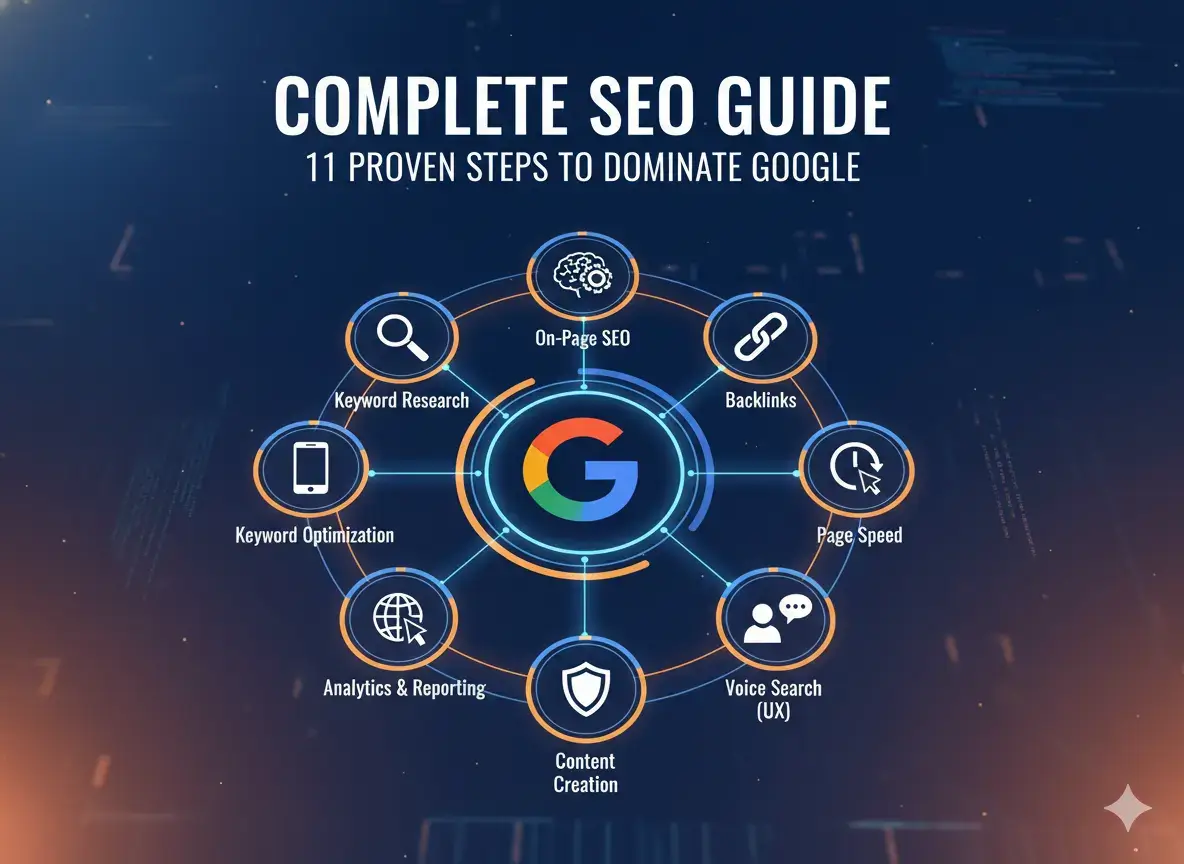
This complete SEO guide covers the entire search engine optimization system in one place. You will learn what SEO is, how Google ranks pages, what tasks to prioritize, and how to build a strategy that fits your business.
No filler. No vague advice. Just 11 clear steps built for 2026 and beyond.
Whether you run a small business, manage a marketing team, or work with an agency, this guide is your authoritative reference.
Table of Contents
What to Expect From This Complete SEO Guide
This guide is structured as an 11-step learning journey. Each step builds directly on the previous one.
You can read it start to finish or jump to the step most relevant to where you are right now. Every section links to a dedicated deep-dive article for further reading.
Use the cluster library at the end to work through each topic in the recommended order.
Step 1: What Is SEO?
Quick answer: SEO stands for Search Engine Optimization. It is the practice of improving your website so it ranks higher in organic (unpaid) search results. Higher rankings bring more qualified visitors without paid advertising costs.
Google processes billions of web pages and ranks the most relevant, authoritative results for every query. SEO is everything you do to earn one of those top positions.
Organic search drives over 53% of all web traffic globally. It is the highest-ROI long-term traffic channel for most businesses.
Why SEO Matters More in 2026
Google’s AI Overviews now appear above traditional results for millions of queries. These AI-generated summaries cite content from high-authority web pages.
Strong SEO in 2026 earns you two placements. You can appear in both the organic results and inside the AI Overview summary.
The businesses dominating search right now invested in genuine, helpful content backed by technical health. That is exactly what this complete SEO guide will help you build.
For a full explanation of SEO mechanics, read: What Is SEO: 7 Powerful Facts That Change Everything.
Step 2: How Google Decides Who Ranks
Google’s ranking process happens in three stages. Missing any stage means your pages will not appear in search results.
Stage 1: Crawling
Googlebot follows links across the internet to discover web pages. Pages blocked by robots.txt, hidden behind login walls, or missing internal links may never be crawled.
Crawlability is the first prerequisite for ranking. Fix it before anything else.
Stage 2: Indexing
After crawling, Google adds pages to its index. Only indexed pages can appear in search results.
Pages with thin content, duplicate content, or a noindex directive get excluded. Use Google Search Console’s Coverage report to check which of your pages are indexed.
Stage 3: Ranking
When a user searches, Google scores all indexed pages against hundreds of signals. The page best satisfying the user’s intent wins the top position.
The most influential ranking signals are: E-E-A-T (Experience, Expertise, Authoritativeness, Trustworthiness), Core Web Vitals, backlink quality from trusted referring domains, and content relevance depth.
Step 3: The 3 Pillars of SEO Every Business Must Master
All SEO work belongs to one of three pillars. Weakness in any single pillar limits your results site-wide.
Pillar 1: On-Page SEO
On-page SEO covers every element you optimize directly on your pages. This includes title tags, H1 headings, meta descriptions, content depth, keyword usage, internal links, and image alt text.
On-page signals tell Google what each page is about and whether it deserves to rank. These are entirely within your control.
Start here before investing in off-page or technical improvements.
Pillar 2: Off-Page SEO
Off-page SEO refers to authority signals from outside your website. Backlinks from trusted domains remain Google’s strongest external ranking signal.
Digital PR campaigns, guest posting on industry publications, and local business citations all build off-page authority. One editorial link from Search Engine Journal or a respected niche publication carries more weight than hundreds of low-quality directory links.
Pillar 3: Technical SEO
Technical SEO covers your site’s infrastructure. This includes crawlability, indexation, page speed, Core Web Vitals, mobile usability, structured data, and canonical tags.
Outstanding content on a technically broken site will not rank. Fix the technical foundation first, then build content and links on top.
For the complete technical task list, visit: Technical SEO Tasks: 25 Critical Fixes That Boost Rankings.
Step 4: What Is an SEO Campaign?
Quick answer: An SEO campaign is a structured, goal-driven initiative to improve specific keyword rankings within a defined timeframe. It combines technical fixes, content creation, and link building into a coordinated plan with measurable milestones and monthly reporting.
Unlike ongoing SEO maintenance, a campaign has clear goals, a defined timeline, and specific KPIs to measure against.
The 5 Phases of a Complete SEO Campaign
Every successful SEO campaign follows these five phases in order:
- Audit and Discovery (Weeks 1-2): Technical audit, content audit, and competitor gap analysis using tools like Screaming Frog and Ahrefs.
- Strategy and Keyword Mapping (Weeks 2-3): Define KPIs, prioritize target keywords, map pages to search intent.
- Technical and On-Page Optimization (Weeks 3-6): Fix crawl errors, update title tags, add schema markup, improve internal links.
- Content Creation and Link Building (Months 2-5): Publish pillar and cluster content, execute digital PR outreach for backlinks.
- Measurement and Iteration (Ongoing): Monthly KPI reporting, optimize based on ranking and traffic data.
SEO Campaign Timeline: Realistic Expectations
| Timeframe | What to Expect |
|---|---|
| Month 1 | Audit complete, technical fixes live |
| Month 2-3 | First ranking movements visible |
| Month 3-6 | Organic traffic growing measurably |
| Month 6-12 | Compound growth, ROI becoming clear |
| Month 12+ | Sustained momentum, expand to new clusters |
For the complete campaign blueprint, read: What is SEO Campaign: 5 Proven Phases That Drive Real Growth.
Step 5: The SEO Task System That Drives Consistent Rankings
Quick answer: SEO tasks are specific, recurring actions that move rankings forward. They divide into four categories: technical, on-page, off-page, and analytics. Each category requires a different frequency and a different toolset.
The biggest mistake practitioners make is treating SEO tasks as a flat to-do list. Tasks need a cadence. The right task at the right frequency is what compounds into rankings.
The Master SEO Task Cadence
| Task | Frequency | Primary Tool |
|---|---|---|
| Check GSC for crawl errors | Weekly | Google Search Console |
| Publish new content | Weekly | CMS |
| Review organic traffic | Weekly | GA4 |
| Full site crawl | Monthly | Screaming Frog |
| Competitor analysis update | Monthly | Ahrefs |
| Link building outreach | Monthly | BuzzStream |
| Full content performance review | Quarterly | GA4 plus GSC |
The 5 Tasks With the Highest Impact
- Fix crawl errors blocking priority pages
- Optimize pages sitting in positions 5-20
- Earn quality backlinks to your best content
- Publish content targeting high-intent, low-competition keywords
- Improve title tags on pages with high impressions but low CTR
For the complete type-by-type breakdown, visit: SEO Tasks: 40 Proven Actions That Skyrocket Rankings.
Step 6: Can SEO Actually Work for Your Business?
Quick answer: Yes. SEO works for almost every business type, industry, and budget. The speed and scale of results depend on your competition level, content quality, technical health, and execution consistency.
Local businesses, eCommerce retailers, B2B SaaS companies, and personal brands all use SEO successfully. The strategy differs by business model, but the underlying system is the same.
What SEO Can Do
- Increase organic visibility for keywords your ideal customers search
- Drive consistent, compounding traffic without ongoing ad spend
- Build brand authority and trust through prominent search placement
- Generate qualified leads and sales at scale over time
What SEO Cannot Do
- Guarantee specific rankings on any keyword
- Produce meaningful results in under 30 days for competitive terms
- Replace all other marketing channels entirely
- Overcome a technically broken or low-quality website
For an honest, detailed answer to every SEO question business owners ask, read: Can SEO Help My Business: 8 Honest Answers That Work.
Step 7: How to Choose the Right SEO Strategy for Your Business
Quick answer: Match your SEO strategy to four factors: your target audience (local or national), your primary goal (leads, sales, or authority), your available resources (DIY, freelancer, or agency), and your competitive timeline (quick wins or long-term authority building).
Choosing the wrong strategy wastes months. A local restaurant investing in national content SEO will not get more customers. A SaaS company building only local citations will not rank for product keywords.
The 4 Primary SEO Strategy Types
Local SEO: For businesses serving a specific city or region. Core focus is Google Business Profile optimization, NAP citation consistency, and location-specific content.
Content-Led SEO: For B2B brands, SaaS products, and publishers targeting national audiences. Core focus is topical authority through pillar and cluster content architecture.
Technical-First SEO: For large sites, eCommerce stores, or recently penalized websites. Core focus is fixing crawl architecture, Core Web Vitals, and duplicate content before adding anything new.
eCommerce SEO: For online retailers. Core focus is category page optimization, product schema markup, and managing faceted navigation across large catalogs.
Business Type to Strategy Decision Matrix
| Business Type | Primary Strategy | First Action |
|---|---|---|
| Local service business | Local SEO | Optimize Google Business Profile |
| Online retailer | Technical plus eCommerce SEO | Category page audit |
| B2B or SaaS | Content-led SEO | Pillar and cluster content plan |
| Blog or publisher | Content authority SEO | Topical depth review |
| New website | Technical foundation first | Site audit plus crawl setup |
For the complete decision guide with worked examples, visit: How to Choose the Right SEO Strategy: 4 Proven Frameworks.
Step 8: The SEO Definitions You Must Know
You cannot optimize what you cannot define. These are the terms used throughout this guide and across the SEO discipline.
Organic Traffic: Visitors arriving via unpaid search results. The primary output metric of any SEO campaign.
SERP: Search Engine Results Page. Contains organic results, paid ads, featured snippets, People Also Ask boxes, and AI Overviews.
Backlink: A link from another website pointing to yours. One of Google’s most powerful ranking signals.
Domain Rating (DR): Ahrefs’ score measuring overall backlink profile strength on a scale from 0 to 100. Higher equals more competitive authority.
E-E-A-T: Experience, Expertise, Authoritativeness, and Trustworthiness. Google’s framework for evaluating content credibility and creator credentials.
Core Web Vitals: Google’s three performance metrics: LCP (loading speed), INP (interactivity), and CLS (visual stability).
Schema Markup: Structured code that helps Google understand what your content means. Enables rich results like FAQ dropdowns, review stars, and product prices.
Featured Snippet: The highlighted answer box that appears above all organic results. Earned through structured, direct-answer content and proper formatting.
Canonical Tag: An HTML element telling Google which version of a URL is the preferred one. Prevents duplicate content issues.
For 60+ definitions covering every layer of SEO, visit the full: SEO Glossary: 60 Essential Terms Every Marketer Needs.
Step 9: The Best SEO Tools for Every Budget
You do not need expensive software to start. These tools cover everything this guide describes.
Free Tools (Install All of These First)
Google Search Console: The single most important free SEO tool. Tracks rankings, impressions, click-through rates, crawl errors, and Core Web Vitals across your entire site.
Google Analytics 4: Tracks all website traffic including organic search. Configure conversion goals on day one to measure SEO’s actual business impact.
Google Business Profile: Essential for any business serving a local area. A fully optimized GBP profile delivers faster ranking results than almost any other single action.
Ahrefs Webmaster Tools: Free version includes site auditing, basic backlink data, and keyword insights. A significant upgrade over relying on Search Console alone.
Paid Tools Worth Investing In
Ahrefs: Industry standard for backlink analysis, keyword research, competitor research, and rank tracking. The Keywords Explorer and Site Audit tools are particularly powerful.
SEMrush: Comprehensive platform for keyword tracking, technical auditing, and competitive intelligence. Excellent for agencies and larger in-house teams needing detailed reporting.
Screaming Frog SEO Spider: Desktop crawler that audits your entire site for broken links, missing tags, redirect chains, and duplicate content. Free for sites up to 500 pages.
Step 10: How to Measure SEO Success Accurately
Quick answer: Measure SEO success using five KPIs: organic traffic growth, keyword ranking changes, organic click-through rate, referring domain growth, and organic conversions. Track all five monthly from the start of your campaign.
Rankings are the leading indicator. Traffic follows rankings. Conversions follow traffic. Tracking all three tiers ensures you always know where your campaign stands.
The 5 Essential SEO KPIs
| KPI | Tool | Target |
|---|---|---|
| Organic sessions | GA4 | 10-20% growth per quarter |
| Target keyword positions | Ahrefs or SEMrush | Page 1 by month 6 |
| Organic CTR | Google Search Console | Above 3% for page 1 placements |
| Referring domains | Ahrefs | 5-15 new per month |
| Organic conversions | GA4 with goals | Positive trend by month 4-6 |
The KPI Growth Timeline
Month 1-2 establishes your baseline. Month 3 shows first impressions growth. Month 4-5 brings organic traffic increase. Month 6 delivers measurable conversions from organic search.
For benchmarks, vanity metric warnings, and a full reporting framework, read: SEO Campaign KPIs: 8 Proven Metrics for Real Results.
Step 11: Your 7-Day Action Plan to Start Right Now
You now have the full SEO system. The most important thing is to start.
Day 1: Install Google Search Console. Verify your website and submit your XML sitemap immediately.
Day 2: Install Google Analytics 4. Connect it to your site and create at least one conversion goal.
Day 3: Run Screaming Frog across your site (free up to 500 pages). Fix any broken links or crawl errors found.
Day 4: Audit your top 5 pages. Check every title tag, H1 heading, and meta description.
Day 5: Research 15-20 keyword targets using Ahrefs Webmaster Tools or Google’s autocomplete and People Also Ask features.
Day 6: For local businesses, complete your Google Business Profile fully. Every field matters.
Day 7: Write and publish your first keyword-targeted content piece using the guidance in the SEO Tasks cluster.
The Complete SEO Knowledge Library
Each step in this guide connects to a dedicated deep-dive article. Work through them in the recommended order for maximum compounding impact.
Frequently Asked Questions
What is the most important factor in SEO?
No single factor dominates. SEO success requires relevance (content matching search intent), authority (quality backlinks and E-E-A-T), and technical health (crawlability and page speed). Weakness in any area limits the other two.
How much does SEO cost in 2026?
DIY SEO costs $0-$500 per month in tools. Freelance SEO ranges from $500-$2,500 per month. Full agency campaigns start at $2,000 per month and scale with scope and competition level.
Can I do SEO myself?
Yes, especially for small businesses or new websites. The fundamentals are fully accessible to non-experts. Specialized help becomes valuable as competition increases and site complexity grows.
How long does it take to see SEO results?
Meaningful ranking improvements typically appear within 3-6 months. Significant organic traffic growth emerges at 6-12 months. New domains in competitive industries may take 12-18 months to reach full momentum.
Is SEO better than paid advertising?
They serve different purposes. Paid ads deliver immediate traffic that stops when budgets stop. SEO takes longer to build but compounds over time, delivering sustainable organic traffic with no per-click cost.
What is E-E-A-T in SEO?
E-E-A-T stands for Experience, Expertise, Authoritativeness, and Trustworthiness. Google uses these signals to evaluate content credibility. Strong E-E-A-T helps content rank in competitive or high-stakes categories like health, finance, and legal.
Key Takeaways
- A complete SEO guide covers three pillars: on-page, off-page, and technical SEO. All three must work together.
- Google ranks pages through three stages: crawling, indexing, and ranking. Problems at any stage block your pages from appearing.
- SEO campaigns follow five phases: Audit, Strategy, Technical Optimization, Content and Links, Measurement.
- Realistic results: ranking movements at months 2-3, traffic growth at months 3-6, full ROI at months 6-12.
- Five free tools cover the essentials: Google Search Console, GA4, Google Business Profile, Ahrefs Webmaster Tools, and Screaming Frog.
- Measure five KPIs from day one: organic traffic, keyword positions, CTR, referring domains, and conversions.
Start with Step 1 from the cluster library above. Every optimization compounds on the last. The best time to begin was six months ago. The second best time is today.
Thanks for breaking down the SEO process so systematically especially the part about Google’s ranking stages and how they tie into the 3 pillars of SEO. It’s easy to get lost in tactics, but your emphasis on understanding how things work under the hood really helps build a more sustainable strategy. The 5-phase campaign timeline was also a nice touch for setting realistic expectations.