
Spending on SEO But Traffic Isn’t Growing is a reality many business owners face. You pay monthly invoices, review tidy reports, and still see the same flat line in your analytics. The team says to be patient, but patience feels expensive when leads and sales do not follow. This situation is not hypothetical. It happens to local shops, SaaS startups, and national retailers alike: budgets are spent, effort is logged, and the traffic needle barely moves.
This post gives you a practical way out of that cycle. You will learn which signals to watch in Google Search Console, backlink tools, and technical audits so you can tell whether your program needs more time or a new approach. I will explain the leading indicators that predict future growth, how long each usually takes to move, and the common execution mistakes that turn months of work into invisible content.
Read on for 11 honest reasons your SEO spend may not be producing traffic and a clear checklist you can run in your own accounts. Use these checks to decide whether to keep investing, change tactics, or change providers so your next invoice buys progress, not more waiting.
Table of Contents
The Uncomfortable Truth About SEO Spending
There are few experiences in business more quietly demoralizing than writing a monthly check for SEO and watching your traffic reports stay completely flat.
You’ve been patient. You’ve heard the “long game” speech. You’ve reviewed the monthly reports that list everything that was done technical audits, content briefs, backlink outreach and nodded along. But patience, when directed at the wrong thing, is not a virtue. It is a cost.
Here is the uncomfortable truth that the SEO industry rarely volunteers: sometimes the advice to be patient is correct, and the strategy is sound and simply needs time. And sometimes that same advice is being used to justify work that isn’t working, strategy that isn’t sound, or execution that would never produce results even given unlimited time.
The most expensive mistake a business can make in SEO is not spending too much. It is spending consistently on a strategy that is fundamentally flawed without ever identifying the flaw, because everything has been framed as a patience problem rather than an execution problem.
This guide will give you the framework to tell the difference with clarity, honesty, and the specific signals that separate one situation from the other.
Why SEO Spend and Traffic Growth Are Not Automatically Linked
SEO is one of the few marketing channels where spending more does not translate into proportionally more output in the way paid advertising does. In paid search, a higher budget produces more impressions and clicks. The relationship is mechanical, near-immediate, and predictable.
SEO does not work this way. What you pay for in SEO is expertise and effort: strategy, technical work, content creation, and link acquisition. Whether those inputs translate into traffic growth depends entirely on whether:
- The strategy accurately targets queries you can realistically compete for at your current authority level
- The content genuinely satisfies what searchers need at a depth competitors haven’t matched
- The link acquisition builds authority with real, relevant sources rather than simulating it with low-quality ones
- The technical foundation allows Google to efficiently discover, crawl, and understand your pages
- Sufficient time has passed for Google’s systems to process the changes and adjust your rankings accordingly
Every single one of these conditions can fail independently while the others succeed. And any one failure is sufficient to neutralize the results of the rest.
According to research by BrightEdge, organic search drives over 53% of all website traffic across industries more than paid search, social, email, and direct combined. The traffic opportunity is unambiguously real. The question is whether the execution is aligned with how that opportunity is actually captured.
The SEO Maturity Curve: Where You Are and What to Expect
Understanding SEO as a maturity curve rather than a linear investment-to-output relationship is the foundational mindset shift that makes the rest of this guide coherent.
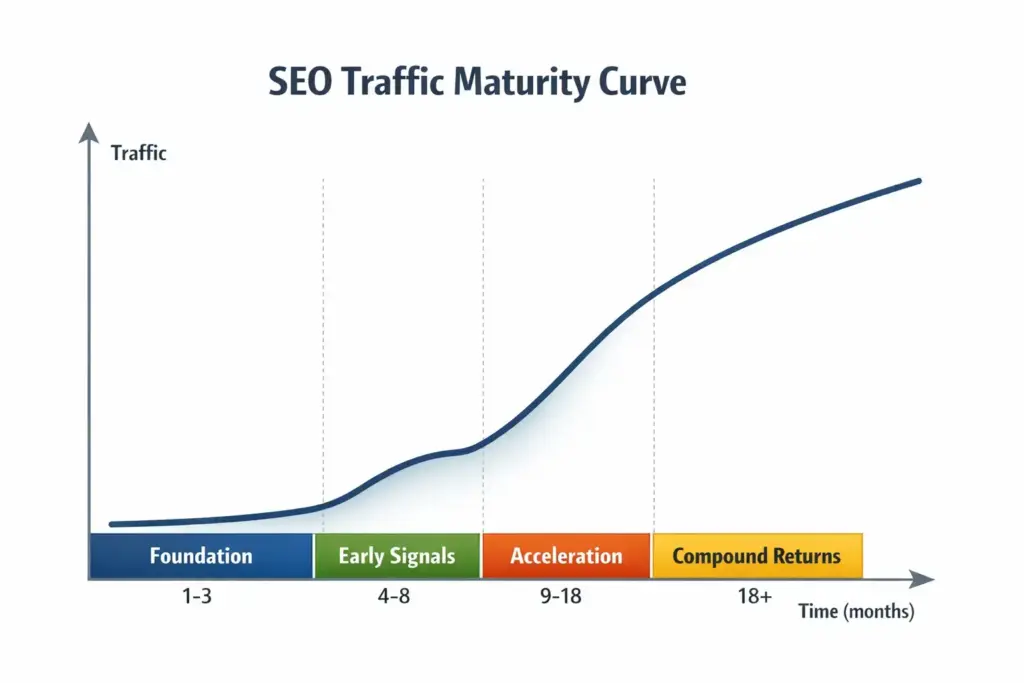
Months 1–3 (Foundation Phase): Technical audit, keyword research, content strategy, baseline measurement. Little to no traffic impact. This is normal you are building the structure, not yet populating it with results.
Months 4–8 (Early Signal Phase): Content is indexed and beginning to rank. Not in the top ten necessarily positions 15–40 for target keywords. Organic impressions in Search Console are growing. A small number of long-tail keywords are generating their first clicks. These are green shoots, not harvest.
Months 9–18 (Acceleration Phase): Content matures in rankings. Pages that spent months in positions 15–30 move into the top ten. Organic traffic begins meaningful growth. Link acquisition compounds, as a site with existing authority is easier to link to than a new one.
Month 18+ (Compound Returns Phase): Content published a year ago continues generating traffic without additional investment. New content ranks faster because the domain has established authority. SEO begins to feel like an asset rather than an expense.
Most businesses evaluate their SEO investment at month three or four during the phase where almost nothing visible is supposed to be happening. They see flat traffic, conclude SEO isn’t working, and either stop or make drastic strategy changes interrupting a compounding process that would have produced results had it been allowed to continue.
11 Honest Reasons Your SEO Spend Isn’t Moving Traffic
Reason 1: Your Budget Is Mismatched to Your Competitive Environment
SEO spend must be proportionate to your competitive landscape. A local service business in a low-competition niche can achieve meaningful results with modest investment. A national e-commerce brand competing in a category dominated by established, high-authority domains needs a substantially larger budget not because SEO is expensive by nature, but because you are attempting to outcompete entities that have been investing in their online presence for years.
The most reliable way to calibrate: examine your top five ranking competitors. Use a free tool like Ahrefs’ Site Explorer or Semrush’s Domain Overview to assess their domain authority and backlink profiles. If their authority scores are dramatically higher than yours and your budget is modest, you are attempting to compete in a heavyweight division with a flyweight’s training regimen.
Reason 2: The Strategy Targets Keywords You Cannot Currently Win
This is one of the most common and most damaging misalignments in SEO strategy. Take your three primary target keywords and search them in an incognito browser. Look carefully at the top five results.
If those results are: large national brands with millions of backlinks, established industry publications that have covered this topic for years, or government or academic sources and your domain has minimal authority you are targeting positions you cannot reach at your current strength level.
The correct strategy is not to abandon those keywords. It is to build a stepping-stone approach: target lower-competition, longer-tail variations first (“emergency plumber Exeter” before “plumber UK”), build ranking equity on those wins, and progress toward competitive terms from a position of accumulating authority rather than from obscurity.
A business that spends 12 months targeting keywords it cannot win has not invested in SEO. It has invested in invisible content.
Reason 3: Your Content Doesn’t Match Search Intent
Search intent is the underlying purpose of a query what the searcher is actually trying to accomplish. Google has become sophisticated at identifying intent and rewarding pages that satisfy it fully.
When someone searches “project management software,” they want to compare options they need a comparison or roundup page. When someone searches “how to use project management software,” they want a tutorial. When someone searches “project management software for architects,” they want a specialized recommendation. These are different pages, different formats, different content types.
Producing content that includes the keyword but delivers the wrong format or wrong depth for the intent behind it is one of the most common reasons well-produced content fails to rank. Google does not just match keywords it models intent and rewards pages whose structure, depth, and content type align with what the searcher was actually trying to do.
Reason 4: Technical Barriers Are Blocking Progress
Consider this: a technically broken website is like a library where the catalogue doesn’t work and half the shelves are locked. The books might be excellent but readers can’t find them.
Common technical blockers that neutralize content investment:
- Pages carrying
noindexmeta tags from a development environment, preventing Google from indexing any of your content - A
Disallow: /rule in robots.txt one misconfiguration that blocks Googlebot from your entire site - JavaScript-rendered content that Google’s crawler cannot process
- Duplicate content spreading ranking signals across multiple nearly-identical URLs
- Core Web Vitals scores that signal poor page experience and trigger ranking suppression
Run a technical audit before assuming content or links are the problem. Technical issues are the one category where a single error can neutralize every other investment you’ve made.
Reason 5: You Have a Backlink Authority Gap You Are Not Closing
Ahrefs’ study of over one billion web pages found that 90.63% of pages get zero organic traffic from Google. The pages in the remaining 9.37% those with real, sustained organic traffic almost universally have one characteristic in common: backlinks from credible external sources.
Backlinks are how the internet establishes trust. When an authoritative, relevant website links to yours, it is vouching for your content. Google’s algorithm treats these endorsements as one of the most reliable signals of quality and trustworthiness in part because they are harder to fake than on-page elements.
If your SEO strategy does not include a consistent, genuine link acquisition component, you are building a one-legged structure. Content and technical SEO without backlink authority produces diminishing returns in competitive environments. This is not a matter of debate it is consistently confirmed by every correlation study examining what high-ranking pages have in common.
Reason 6: The Work Is Being Done, But Done Poorly
This is statistically the most common reason SEO investments fail and the hardest to detect from the outside, because activity is happening. Reports are being filed. Tasks are being checked off. But quality matters, and quantity of work is not a proxy for quality of work.
A practical content quality test for any article published in your name: First, read the top three ranking pages for the query it targets. Is your piece more complete, more clearly explained, and more practically useful? Second, does it contain specific insights, concrete examples, or genuine depth that a reader couldn’t find in five minutes of searching elsewhere? Third, would a subject-matter expert in your industry find it accurate and credible or is it surface-level content that could have been written by someone with only a few hours of research?
If the answer to any of these is no, your content is occupying space on your domain without earning rankings. The same quality test applies to backlinks: a link from a thin, irrelevant site that exists primarily to sell links does not build authority. It can actively trigger algorithmic distrust.
Reason 7: A Manual Penalty or Algorithmic Filter Is Suppressing Your Site
If your website was previously subject to SEO practices that violate Google’s guidelines purchased links, keyword stuffing, content scraping, participation in link networks it may be carrying a penalty that neutralizes legitimate work being done today.
Manual penalties appear in Google Search Console under Security & Manual Actions. If you have an active manual action, every other SEO investment is being made in a context where Google has explicitly decided to demote your site. The penalty must be resolved first.
Algorithmic filters from systems like Google’s SpamBrain are harder to identify but can sometimes be inferred by correlating significant traffic drops with known Google algorithm update dates. Google’s Search Status Dashboard at status.search.google.com provides a public log of confirmed updates.
Reason 8: Your Competitors Have Intensified Their Own Investment
SEO is a relative competition. Rankings are positions on a specific results page, and those positions are always relative to what other sites are doing. If your top competitors have significantly increased their content velocity, link acquisition, or technical investment since you began your SEO program, you may be losing ground in relative terms even if your absolute metrics are improving.
Your content might be better than it was six months ago. But if three competitors have published ten excellent pieces on each of your target topics during that same period while you’ve published two, your relative position has likely declined.
Reason 9: Google Algorithm Updates Have Shifted the Evaluation Criteria
Google releases hundreds of updates annually, including several “core updates” that can substantially shift rankings across entire categories. Core updates are designed to improve search quality and sometimes content that previously ranked well no longer satisfies Google’s evolved quality criteria.
If a core update has placed greater weight on EEAT signals (expertise, experience, authoritativeness, trustworthiness) in your topic area as Google has done extensively in health, finance, and legal verticals content without clear author credentials, institutional authority, or demonstrable real-world experience may be suppressed regardless of its technical optimization.
Staying current with Google’s public guidance on core updates, available through Google’s Search Central Blog, is part of what competent SEO management looks like.
Reason 10: You Are Measuring Only Lagging Indicators
Traffic is a lagging indicator. It reflects decisions, content, and link building that happened months earlier. Evaluating SEO purely by traffic at month three or four is like evaluating the health of a planted crop by checking whether there’s fruit after three weeks.
The leading indicators of SEO progress the signals that reliably predict future traffic growth are: growth in indexed pages, improvement in average position for target keywords in Search Console, increase in total organic impressions, growth in referring domain count, and improvement in Core Web Vitals scores.
If these leading indicators are all moving in the right direction, traffic will follow the lag is a function of how Google processes and responds to improvements, not evidence that the strategy is failing.
Reason 11: Expectations and Investment Are Not Calibrated to the Same Timeline
This is the most honest item on the list. Some businesses invest modestly in SEO and expect results appropriate to a significant investment. Some invest in a highly competitive niche and expect results appropriate to a low-competition one. Some evaluate results after four months in a category where eighteen months is the realistic timeline.
Unrealistic expectations are not the client’s fault. They are almost always the result of inadequate scoping during the sales process. A credible SEO provider should communicate in specific terms, before engagement what timeline is realistic for your specific niche, competitive landscape, and starting authority level. If that conversation never happened, both the expectation and the frustration that follows are understandable.
How to Audit Whether Your SEO Is Actually Working
Instead of looking only at traffic, evaluate these specific data points in your own tools.
In Google Search Console → Performance:
Pull the date range from your SEO start date to today and compare the first 90 days to the most recent 90 days.
- Total Impressions: Healthy growth shows at least 20–40% increase over six months in a moderately competitive niche. Flat impressions mean Google is not increasing its association of your content with relevant queries the content strategy is not working.
- Average Position: Are target keyword positions moving upward? Movement from position 50 to position 20 doesn’t produce meaningful traffic yet, but it is a leading indicator that rankings are building.
- Click-Through Rate: If impressions are growing but CTR is flat or declining, your title tags and meta descriptions need improvement. The content is being seen it’s not compelling enough to click.
In your backlink tool (Ahrefs, Semrush, or Moz):
- Has your referring domain count grown? New, quality referring domains (from real, relevant websites) are the most reliable predictor of future organic traffic growth.
- Is your domain authority or rating score trending upward over six months?
In your CMS or technical audit tool:
- Has the number of indexed pages grown consistently?
- Have previously identified technical issues been resolved and stayed resolved?
If all of these indicators are flat or declining after six or more months of consistent investment, you have evidence of a strategy or execution problem not a timing issue.
Leading vs. Lagging Indicators: The Metric You Should Be Watching
| Metric | Type | What It Tells You | When to Expect Movement |
|---|---|---|---|
| Indexed page count | Leading | Whether content is accessible to Google | Weeks after publication |
| Organic impressions | Leading | Whether Google sees you as relevant | 1–3 months |
| Average keyword position | Leading | How competitive your content is | 2–6 months |
| Referring domain count | Leading | Whether authority is building | Ongoing |
| Core Web Vitals scores | Leading | Technical health | After fixes applied |
| Organic click volume | Lagging | Actual search visibility | 4–9 months |
| Organic traffic sessions | Lagging | Real audience reach | 6–12 months |
| Leads/sales from organic | Lagging | Business outcome | 9–18 months |
The key principle: Leading indicators are the instruments. Lagging indicators are the destination. You navigate by instruments, not by destination. If your leading indicators are moving in the right direction, trust the process and continue. If leading indicators are flat or negative after six months, the instruments are telling you the strategy needs correction.
When to Stay the Course vs. When to Change Strategy
Stay the course when:
- Leading indicators are moving positively (impressions, indexed pages, keyword positions)
- Content quality is genuinely strong and intent-matched
- Link building is producing links from real, relevant websites
- Technical issues are being identified and resolved
- The investment period has been under twelve months in a moderately competitive niche
Change the strategy when:
- No leading indicators are improving after six months of consistent work
- Content is consistently thin, generic, or intent-mismatched
- Backlinks are coming from obviously low-quality sources
- Technical issues identified months ago remain unresolved
- Reporting consistently shows activity without demonstrating outcomes
Change the provider when:
- Direct questions receive vague or evasive answers
- The strategy cannot be explained in clear, specific terms
- You find evidence of black-hat techniques being used without your knowledge
- Transparency about data and methodology is consistently absent
The Question That Separates Patience From Delusion
There is a question that cuts through everything:
“Can you show me, in Google Search Console, where your work has moved any of our metrics in the past 90 days even just impressions?”
A competent SEO team should always be able to answer yes to this after month four. They should be able to open Search Console in front of you, pull a before-and-after comparison, and show you specific pages where impressions have grown, positions have improved, or indexation has increased.
If the answer is “not yet” at month six with no data-backed explanation for why you are not being patient. You are subsidizing ineffective work and calling it an investment.
Patience is a virtue when applied to a process that is working. Applied to a process that is not working, it is an expensive form of hope.
Frequently Asked Questions
Is it possible to invest in SEO for years and see no results?
Yes. SEO executed with the wrong keyword strategy, insufficient content quality, or low-quality link building can produce years of effort with marginal results. This is the most important reason to demand transparency and measure leading indicators consistently not to be skeptical of SEO as a channel, but to hold the specific strategy being executed to an evidence-based standard.
What should I ask my SEO provider to prove progress?
Ask for: a monthly keyword ranking report showing position changes for target keywords, a Search Console screenshot comparison showing impression growth, a list of newly acquired backlinks with the referring domains identified, a content performance report showing which published pieces are generating impressions and clicks, and a technical audit resolution log showing issues found and fixed. Any competent SEO provider can produce all of these within 24 hours of the request.
How much should I realistically budget for SEO?
Budget calibration requires competitive benchmarking, not a fixed number. Look at the organic visibility of your top three ranking competitors using a tool like Ahrefs. Estimate what it would take to build comparable content volume and backlink profiles. Your budget needs to be in the same order of magnitude as what your competitors are investing to realistically compete not identical, but in the same range. The strategy matters enormously too: a smaller budget with excellent strategy often outperforms a larger budget with poor strategy.
Can bad SEO actually damage my website?
Yes in two specific ways. First, black-hat techniques (purchased link networks, keyword stuffing, content manipulation) can result in manual penalties from Google’s webspam team or algorithmic suppression, both of which can dramatically suppress your organic visibility. Second, and more subtly, poor quality content published at volume can dilute your site’s overall quality signals, making it harder for even your good content to rank. Google assesses sites holistically a large volume of thin content affects the perceived quality of the entire domain.
Should I pause SEO while waiting for results?
Pausing is rarely the right answer during the foundation and early signal phases, because SEO compounds and interruptions reset momentum. If you’re in months one through six with a strategy that appears sound based on leading indicator evaluation, continuation is almost always correct. If you’re beyond six months with no leading indicator movement and credible evidence that the strategy is flawed, a pause for strategic reassessment followed by a revised approach is far better than continuing to invest in a direction that is demonstrably not working.
Conclusion
Spending on SEO without seeing traffic growth is frustrating but the emotion of frustration is not evidence that SEO doesn’t work. It is evidence that something specific is not working, and that something needs to be identified with precision rather than concluded with impatience.
The leading indicators are your compass. Impressions, indexed pages, keyword positions, and referring domains are the instruments that tell you whether the strategy is working before traffic confirms it months later. If those instruments are moving positively, trust the process and protect it from premature interruption. If those instruments are flat after six months of consistent investment, something specific needs to change strategy, execution, provider, or all three.
Organic search generates more than half of all web traffic across every industry measured. It is the largest single traffic channel available to any business. The businesses that appear at the top of those results don’t have special access or unfair advantages. They have consistently built content, authority, and technical credibility over time, measured their progress honestly, and adapted their approach based on evidence rather than emotion.
That process is available to every business. The question is whether the investment is being directed by a strategy that deserves patience or one that has been misidentified as patience when the more honest word is something else.
Google’s Search Essentials the official documentation for how pages are evaluated and ranked is available at developers.google.com/search/docs/essentials. Google’s Search Central Blog at developers.google.com/search/blog is the authoritative source for algorithm update communications and search quality guidance.