
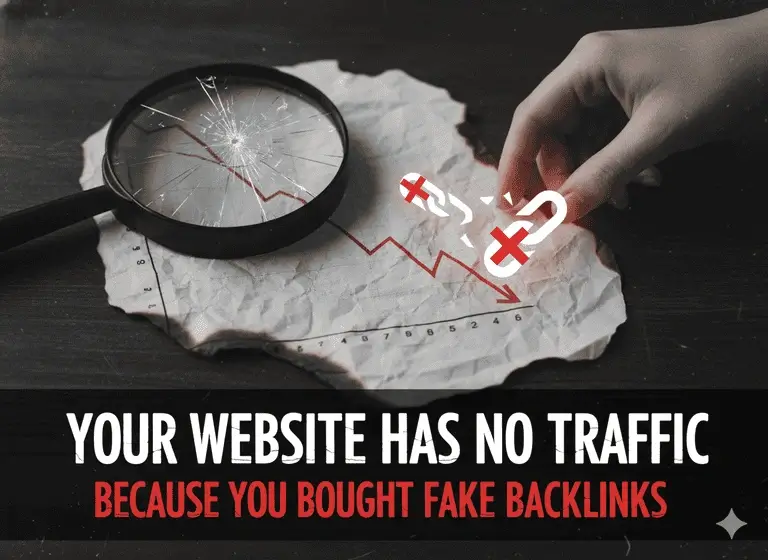
We know the frustration of watching traffic collapse overnight. One day your analytics look healthy, the next day the line drops and your rankings vanish. It feels unfair because you followed advice, invested in backlinks, and expected growth. Instead, you ended up with silence. The truth is that we have faced the same problem, and the cause was clear once we dug deeper: fake backlinks.
Fake backlinks are links sold by sites that exist only to sell them. They have no audience, no editorial standards, and no genuine reason to link to your content. At first, they look like a shortcut. Rankings rise for a few weeks, and you believe the strategy is working. Then Google’s systems catch up. The penalty arrives, and the drop is sharper than the gain. We learned this lesson the hard way, and if you are here, you probably have too.
The good news is that this problem is solvable. Google penalties, whether manual or algorithmic, can be reversed. The process begins with a clear audit of your backlink profile. You identify which links are legitimate, which are suspicious, and which are outright harmful. Then you use the disavow tool to tell Google to ignore the bad ones. Recovery takes patience, but it works. We have walked this path, and it is possible to rebuild stronger than before.
This blog is not just about warning you against fake backlinks. It is about showing you the exact steps to diagnose the issue, clean up your profile, and rebuild with real authority. We will share how to audit links, how to use the disavow tool correctly, and how to create content that earns genuine endorsements. If your site has suffered the same fate as ours, this guide will help you recover and prevent it from happening again.
Table of Contents
The Moment You Realized Something Was Wrong
You checked your analytics one morning and the line was pointing down. Not a small dip. A real drop. Pages that used to bring in steady visitors had gone quiet. Rankings that took months to build had vanished. You had done everything someone told you to do. You had bought the backlinks, watched the numbers go up briefly, and then watched everything fall apart.
That pattern is not random. It is the direct result of how Google treats paid, unnatural links. The good news is that the damage is diagnosable. The better news is that it is reversible if you understand exactly what happened and work through it in the right order.
This article will not just tell you that fake backlinks are bad. You already know that. It will show you exactly what Google sees when it detects them, what happens to your site as a result, and what you need to do to get your traffic back.
What Fake Backlinks Actually Are
Think about how trust works in the real world. If a respected doctor recommends a product to you, that carries weight. If a random stranger on the street offers to recommend you to fifty people for twenty dollars, that carries nothing. It might actually make you look worse. Backlinks work on the same logic.
A backlink is a vote of trust from one website to another. When a website links to your content, it is essentially saying: this is worth reading. Google uses this signal to understand which pages deserve to rank. The more credible websites point to you, the more credible you appear in Google’s model.
A fake backlink comes from a website that was created specifically to sell links. These sites have no real audience, no real purpose, and no editorial judgment. They exist only to manufacture votes. Google has spent years getting very good at identifying exactly this type of site, and the penalty for having a link profile full of them is significant.
Why People Buy Them in the First Place
The pitch sounds reasonable. You need backlinks to rank. Getting real backlinks takes time. Someone offers you a hundred links for a small fee. The shortcut feels logical. In the short term, it sometimes even works. Rankings climb for a few weeks, sometimes a few months, and it looks like the strategy paid off.
The reason it works temporarily is that Google’s systems take time to fully evaluate new links. There is a window where the link juice flows before the quality assessment catches up. This window is what sellers use to prove their product works. They deliver results fast enough for you to feel the win, and disappear before the penalty arrives.
The penalty arrives. It always does. And when it does, the drop is sharper than the gain was.
What Google Actually Sees When You Buy Links
Google does not just count links. It evaluates the entire character of every link pointing to your site. It looks at the domain’s age, traffic, engagement, topical relevance, and link velocity. It looks at whether the anchor text patterns seem natural or engineered. It looks at whether the sites linking to you have any real editorial history.
When you buy links from a link farm, several signals break at once. The linking site has no real traffic. The content on that site exists only to host links, not to serve readers. The anchor text used to link to you often matches your target keyword exactly, which is a pattern Google specifically watches for because real editors do not always link with exact-match text. The velocity of link acquisition often spikes suddenly, which is another red flag.
None of these signals in isolation triggers a penalty. All of them together paint a picture that Google’s algorithm reads clearly: this is manipulation.
The Penalty Mechanism: Manual vs Algorithmic
There are two ways a fake backlink profile damages your site, and they work differently.
The first is a manual action. A Google reviewer looks at your link profile and determines it violates their guidelines. You receive a notification in Google Search Console, and your rankings are suppressed until you resolve it and submit a reconsideration request. Manual actions are serious but they are visible. You know exactly why you are being penalized and you have a formal path to recovery.
The second is algorithmic. Google’s systems, particularly Google Penguin, continuously evaluate link profiles. If your profile looks manipulative, the algorithm simply discounts your links or depresses your rankings without notifying you. There is no notification. You just see your traffic fall and have to diagnose the cause yourself. This is the more common experience for people who bought links from third-party sellers.
Both situations are recoverable. But you need to know which one you are dealing with before you act.
How to Audit Your Backlink Profile
Open Google Search Console and navigate to the Links section. This gives you a view of what Google has indexed about your link profile. Look at the top linking sites and the top anchor texts. If you see a large number of links from websites you have never heard of, and if your anchor text list is dominated by your exact target keywords, you have a problem worth investigating.
Download your full backlink list. Tools like Ahrefs, Semrush, or Moz can pull a more comprehensive picture than Search Console alone. Go through the linking domains and ask three questions about each one. Does this site have real content that serves real readers? Is this site topically related to my website? Did someone at this site make an editorial choice to link to me, or does it look like the link was placed artificially?
Separate your links into three categories. Keep the clearly legitimate ones. Flag the ones that look suspicious. Mark the ones that are obviously from link farms. This categorization will drive everything you do next.
The Penalty Mechanism Table
| Signal Google Evaluates | Healthy Link Profile | Fake Link Profile |
|---|---|---|
| Linking domain traffic | Real visitors present | Near zero traffic |
| Content quality of linking site | Original, useful content | Thin or auto-generated |
| Anchor text distribution | Mixed, natural phrases | Heavy exact-match keyword |
| Link velocity | Gradual growth | Sudden spikes |
| Topical relevance | Related to your niche | Random or unrelated |
| Editorial intent | Links placed in context | Links in footer or sidebar with no context |
The Disavow Process: What It Does and What It Cannot Do
Google provides a tool called the Disavow Tool inside Search Console. You upload a file listing the domains or URLs you want Google to ignore when evaluating your link profile. Google then excludes those links from their assessment of your site. This is how you tell Google: I did not want these links, please do not hold them against me.
The disavow tool works, but it has limits. It does not instantly restore rankings. It can take several weeks or even a couple of months for Google to process the file and for the effects to show in your rankings. If you had a manual action, you still need to submit a reconsideration request after disavowing. The disavow tool alone does not lift a manual penalty.
There is also a risk to using it incorrectly. Disavowing good links by mistake removes genuine authority from your profile. This is why the audit step matters so much. You want to be precise. Disavow only what you are confident is harmful.
How to Rebuild After Fake Links
Once you have cleaned up your link profile, the rebuilding phase begins. This is where patience matters more than anything else. Recovery from a link penalty is not an overnight event. Depending on the severity of the problem and how aggressively Google penalized your site, you may be looking at two to six months before rankings return to their previous levels.
Start by fixing what is on your own site first. Your content quality, your internal linking structure, your page speed, and your user experience signals are all things you fully control. Getting those right gives you a foundation that does not depend on external factors. It also sends signals to Google that your site is being actively maintained by someone who cares about quality.
Then start earning real links. Write content that is genuinely better than what currently ranks on your target topics. Reach out to websites in your niche and offer something useful: a guest post, a data study, a resource that complements something they already link to. One real link from a real website with real readers is worth more than a hundred fake ones, and it does not carry any risk.
What Real Link Building Looks Like
Real link building is slower. There is no way around that. A journalist mentions your site because you gave them useful data. A blogger in your industry links to your guide because it explains something better than anything else they found. A forum user shares your article because it genuinely helped them solve a problem. These links happen because your content earned them.
This process takes months, not days. But every link you earn this way adds to an asset that compounds over time. Your authority grows. Your rankings become more stable. Your traffic becomes more predictable. Compare that to the fake link cycle: a brief spike, a penalty, a crash, a recovery process, a return to zero. The real path is slower at the start and faster in the long run.
Google’s own documentation on link schemes is worth reading. They are clear about what constitutes a violation and what constitutes legitimate link building. The more you understand the actual rules, the more confidence you have in building the right way.
How to Prevent This From Ever Happening Again
The prevention is simple once you understand the mechanism. Never pay for links. Not from a vendor, not from a network, not from a service that promises “high-quality backlinks” at scale. If someone is selling links in bulk, those links are not natural. Natural links do not come in bulk packages.
Evaluate every link opportunity by asking one question: would this link exist if no money changed hands? If the answer is yes, it is probably a legitimate editorial link. If the answer is no, it is a paid link regardless of what the seller calls it.
Build your link acquisition strategy around content creation, genuine relationships, and useful resources. These take longer to produce results, but they produce results that hold.
Frequently Asked Questions
What exactly are fake backlinks?
Fake backlinks are links placed on websites that exist specifically to sell links rather than serve real readers. These sites have no genuine editorial standards and no real audience. They sell space on their pages to anyone willing to pay, which means the links they produce have no authentic endorsement behind them.
How long does it take to recover from a fake backlink penalty?
Recovery time depends on whether you have a manual action or an algorithmic penalty. Manual actions can be resolved in weeks once you disavow, clean up, and submit a reconsideration request. Algorithmic penalties can take two to six months to fully reverse after the disavow file is processed.
Can I just delete my website and start over to avoid the penalty?
Starting over with a new domain does not carry over the penalty, but it also does not carry over any of the authority you built legitimately. You lose everything in both directions. Cleaning up and recovering your existing site is almost always the better path unless the penalty is catastrophic and the site has no legitimate authority to preserve.
Will the disavow tool remove all my fake backlinks?
The disavow tool does not remove the links. It tells Google to ignore them when evaluating your site. The links still exist on those third-party sites. What changes is that Google no longer counts them against you or for you.
Do bought backlinks ever work permanently?
Some sites buy links and never face penalties. This is usually because the volume was small, the links came from sites that looked marginally legitimate, or the algorithm has not caught up to them yet. It is not a sustainable strategy. Google’s ability to detect unnatural link patterns has improved significantly with each algorithm update, and what passes today may not pass tomorrow.
How do I know if I have a manual penalty versus an algorithmic one?
Go to Google Search Console and check the Manual Actions section under Security and Manual Actions. If there is an active manual action, it will be listed there with a description. If that section is clean but your traffic still dropped significantly, you are dealing with an algorithmic issue, likely Penguin.
What is the safest way to build backlinks for a new site?
Create genuinely useful content. Publish original research, comprehensive guides, or tools that solve real problems in your niche. Reach out to relevant sites and publications. Build relationships before you ask for anything. This is slower but it produces a link profile that strengthens over time rather than creating liability.
Conclusion
Buying fake backlinks is a shortcut that reverses on you. The gain is temporary. The damage is real and can take months to undo. What matters now is that you understand exactly what happened and have a clear path forward.
Audit your link profile. Disavow what you know is harmful. Rebuild from your own content first. Then earn links through work that is worth linking to. That sequence, done properly, restores what was lost and builds something more stable than what you had before.
About the Author
Ajitkumar Gupta is a digital marketing practitioner focused on SEO strategy, traffic recovery, and building online systems that produce consistent results. His work is grounded in execution, not theory, with a specific focus on diagnosing and fixing what is actually broken rather than adding more complexity to an already complicated situation.
Need Help Recovering Your Traffic?
If your rankings dropped and you are not certain whether fake backlinks are the cause, a proper audit will make it clear. The audit tells you what you are dealing with. The strategy tells you what to do about it. Both can happen faster with someone who has been through this before.
Reach out and let’s figure out what is actually going on with your site.