Does Google My Business Help SEO? 5 Proven Truths

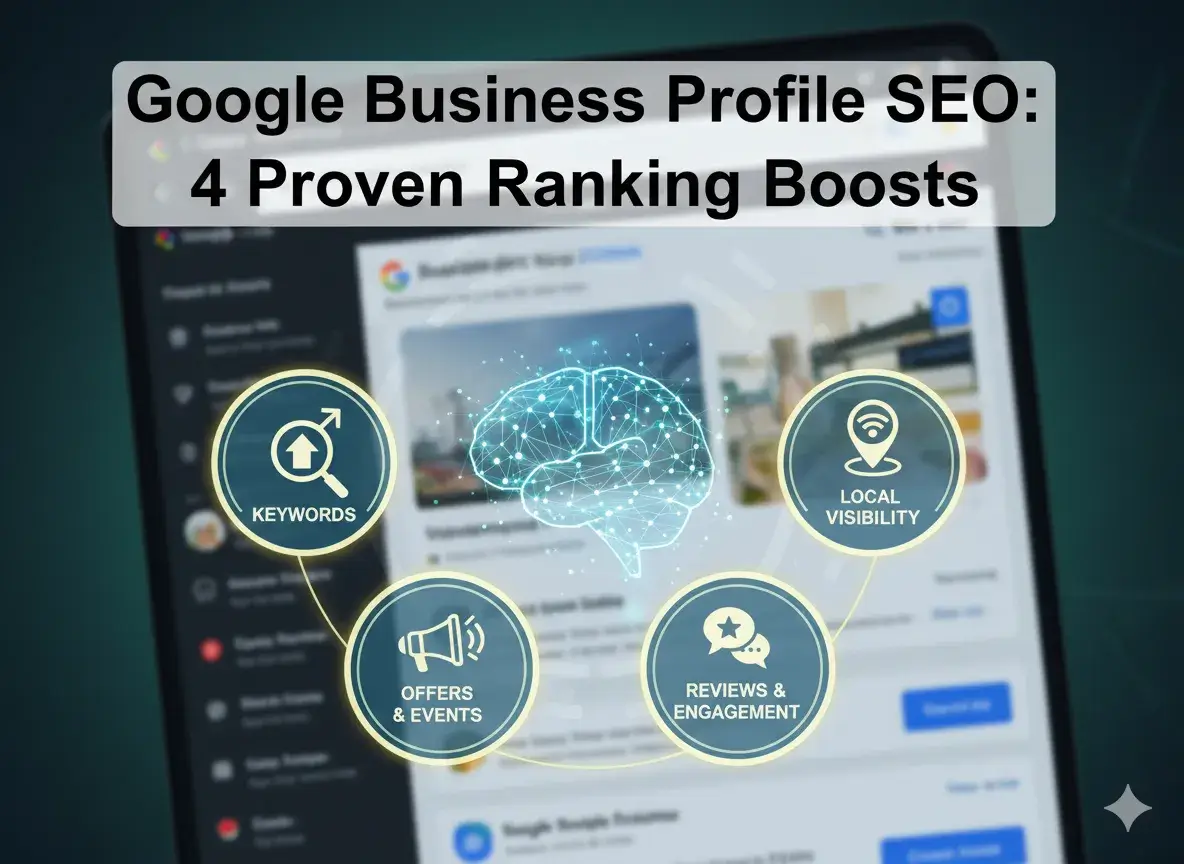
Does Google My Business help SEO? Yes, significantly and directly. Google Business Profile signals control 32% of all local map pack ranking factors. That is the single largest category in the entire algorithm.
Without an optimized GBP, a business cannot appear in the Local Pack, Google Maps, or Google’s AI Overviews for local queries. With one, it competes for the positions that capture the majority of clicks in local search.
This page explains the five specific mechanisms, what Google actually measures, and what to act on first for the fastest impact.
Table of Contents
Does Google My Business Help SEO? The Direct Answer
Yes. Google My Business, now officially called Google Business Profile (GBP), directly drives local SEO rankings through five specific mechanisms.
It determines whether your business is even eligible to appear in the Local Pack. It tells Google which searches you are relevant for through your category and service data. It builds your Prominence signal through reviews and profile completeness. It generates behavioral engagement data that feeds back into your ranking. And it now supplies content to Google’s AI Overviews, which appear above the Local Pack for 40% of local queries.
Without a verified, optimized GBP, you cannot rank in the Local Pack under any conditions. With one, you are competing for the positions that capture the majority of clicks in local search.
What Is Google My Business in 2026?
Google rebranded Google My Business to Google Business Profile in November 2021. The underlying product controls how your business appears across Google Search, Google Maps, the Local 3-Pack, and the Knowledge Panel.
When someone searches “accountant near me” or “Italian restaurant Manchester,” Google uses GBP data as the primary input to select the three businesses shown in the Local Pack. Your listing is what the customer sees before they ever click to your website: your name, rating, hours, photos, services, and direct call and directions buttons.
You might be thinking: “I set up my GBP a few years ago. Does it still matter if I have not touched it since?”
Yes, and this is important. Google now weights recent profile activity alongside historical completeness. A profile set up in 2022 and never updated is gradually losing ground to actively maintained profiles in 2025 and 2026. Static profiles decay. Active ones compound.
Does Google My Business Help SEO? 5 Proven Mechanisms
Mechanism 1: GBP Signals Control 32% of Local Pack Rankings
The Whitespark 2026 Local Search Ranking Factors survey, the most rigorous annual study of local ranking signals in the industry, identifies GBP on-profile signals as the single largest ranking category.
To understand what 32% means practically: all review signals together account for 17%. All link signals account for 16%. All on-page website signals account for 16%. All citation signals account for 7%. Behavioral signals account for 9%.
GBP optimization alone outweighs every other category combined. If two businesses are identical on every other signal, the one with the better-optimized GBP wins the Local Pack position. Every time.
Mechanism 2: Your Primary Category Determines Which Searches You Compete For
Inside your GBP, one field determines more than any other: your primary business category.
Your category tells Google which search queries to include you in. A personal trainer who selects “Fitness Centre” competes for different searches than one who selects “Personal Trainer.” A boiler engineer who selects “Plumber” is invisible for central heating installation searches regardless of how strong everything else is.
38% of businesses in the top three local positions include their target keyword in their business name (Semrush, 2026). Most businesses cannot manufacture that advantage. But choosing the most specific, accurate primary category is the controllable equivalent, and it is available to everyone.
The question that naturally follows: how do I know which category to choose?
Search your core service keyword in Google from your target city. Open the top three Local Pack results. Note their primary categories. The pattern you see is your answer. Choose the most specific, accurate option available. This research takes 20 minutes and produces the most ranking impact per minute of any action in local SEO.
For how category selection interacts with every other GBP signal, read our Google Business Profile ranking factors guide.
Mechanism 3: A Complete Profile Converts 70% Better and Ranks in More Searches
Google’s own research shows customers are 70% more likely to visit a business with a complete Google Business Profile. They are 50% more likely to make a purchase.
These conversion numbers matter because they explain why profile completeness affects rankings. Google’s behavioral signals detect when profiles that appear in Local Pack results earn more clicks, more calls, and more direction requests. A complete, appealing profile earns more of these interactions. More interactions produce stronger behavioral ranking signals. Stronger signals improve ranking positions. Higher positions generate more impressions.
The completeness benefit is also direct. Every completed field gives Google more data to match against queries. A plumbing company that lists “Boiler Installation,” “Emergency Pipe Repair,” and “Drain Unblocking” as separate service entries appears in searches for all three. One with only “Plumbing Services” appears in none specifically.
The sections most businesses leave empty are precisely the ones that carry extra ranking weight: Services, Attributes, Products, and Business Description. Filling them takes 45 minutes. The benefit lasts for years.
For the complete field-by-field guide, read our guide on how to optimize your Google Business Profile.
Mechanism 4: Reviews on Your GBP Account for 17% of Local Pack Ranking Weight
Reviews on your Google Business Profile are a core Prominence signal. They account for up to 17% of local map pack ranking weight.
Combined with GBP on-profile signals, that means your GBP and its associated reviews together control approximately 49% of your entire local search position. Nearly half.
Google does not just count reviews. It measures four dimensions simultaneously.
Volume: Total reviews relative to competitors. Businesses in top-3 positions average 561 reviews at 4.8 stars.
Velocity: How many new reviews arrive each month. This is the most important dimension most businesses are not tracking. 73% of consumers only trust reviews from the last 30 days.
Recency: When your most recent review was posted. A profile with its last review from six months ago signals potential business decline to Google’s algorithm.
Content: The specific words customers use. When reviews naturally mention your services and location, those keywords add Relevance signals to your profile.
The hesitation most businesses have at this point: “Getting reviews feels awkward and pushy.”
The businesses in the top three positions in your market have 561 reviews because they asked. They asked systematically, not occasionally. The ask does not have to feel pushy. “I’d really appreciate it if you shared your experience in a Google review” said at the moment the customer is most satisfied is received as a genuine request, not a sales tactic.
Mechanism 5: Your GBP Now Feeds Google’s AI Overviews
40% of local business queries now display a Google AI Overview above the Local Pack. In categories like legal, healthcare, and home services, that figure exceeds 62%.
These AI summaries pull content from your GBP data, your review text, and your website. A business without a complete, active GBP is excluded from both the Local Pack and the AI layer above it. Both visibility losses compound simultaneously.
This is not a future development to monitor. It is happening in your category and your market right now. Every query where a competitor appears in an AI Overview and you do not is a visibility loss occurring thousands of times per month.
Does GBP Affect Organic Search Rankings Too?
GBP directly affects Local Pack rankings. Its effect on traditional organic blue-link rankings is indirect but real.
A well-optimized GBP generates more branded searches (people searching your business name directly after seeing you in the Local Pack). Google uses branded search volume as a trust signal in its organic algorithm. Rising branded searches build organic authority over time.
GBP also drives more direct website visits. Those visits generate behavioral signals (time on site, pages viewed, return visits) that reinforce your domain’s authority in organic results.
The practical takeaway: businesses that invest in both GBP optimization and organic SEO consistently outperform businesses that treat them as competing choices. They are complementary. Each amplifies the value of the other.
What Actually Happens Without an Optimized GBP
Without a verified GBP, your business is absent from three of the highest-value positions in local search: the Local Pack, Google Maps, and the Knowledge Panel.
In 2026, the cost extends further. AI Overviews, ChatGPT Search, Perplexity, Siri, Alexa, and Google Assistant all draw from GBP data for local queries. An absent or incomplete profile means invisible across every discovery layer simultaneously.
The gap between optimized and unoptimized profiles is not narrowing. It is widening with every algorithm update and every new AI search feature. Every month a profile stays incomplete is a month of compounding disadvantage.
The 5 GBP Actions That Move Rankings Fastest
Action 1: Research and Set Your Correct Primary Category
This single change produces more ranking movement than any other individual action. Search your keyword from your target city, examine the top three competitors’ primary categories, and select the most specific, accurate option that genuinely describes your core business. Done correctly in 20 minutes. Effects visible within 2 to 4 weeks.
Action 2: List Every Service as a Separate Entry
Open your Services section. Add every individual service your business offers with its own name and 2-sentence description. This is the most underused ranking opportunity in GBP and the one that most directly expands the range of specific queries you appear for.
Action 3: Write a 750-Character Business Description
Write it for the customer who has never heard of your business. Explain what you do, where you operate, what credentials you hold, and what makes your service worth choosing. Mention your primary service and city once each, naturally. Use all 750 characters.
Action 4: Set Up Your Review Generation System Today
Get your direct review link from the GBP dashboard under “Get More Reviews.” Add it to your email signature, invoice footer, and follow-up message template. Send your first review request to a satisfied recent customer today. This is the only action that produces compounding returns starting from the day you begin.
Action 5: Publish One GBP Post Every Week
What’s New posts expire after 7 days. Post weekly, minimum. This maintains the profile activity signal that distinguishes actively managed listings from dormant ones. Each post takes 5 to 10 minutes.
Frequently Asked Questions
Does Google My Business help SEO for a brand-new business with no reviews?
Yes. A newly verified, fully completed GBP with the correct primary category, complete service listings, and professional photos begins ranking for relevant local queries immediately after verification. Reviews accelerate and deepen that ranking over months, but a well-optimized profile earns Local Pack visibility from day one.
My GBP has been set up for two years but I am still not ranking well. Why?
The most common cause: the primary category is wrong or too broad. The second most common: a significant review gap compared to the top-ranked businesses in your area. Run through both checks before anything else. A category correction produces movement within 2 to 4 weeks. Closing a review gap requires sustained monthly generation.
Does responding to Google reviews affect my rankings?
Yes. Review response rate is a confirmed active profile management signal. Beyond rankings, every 25% of reviews you respond to improves your GBP conversion rate by 4.1% (Semrush, 2026). With 54% of reviews receiving no reply, consistent responses are a direct competitive advantage.
How often should I update my Google Business Profile?
Post at minimum once per week. Upload 3 to 5 new photos every month. Update hours immediately when they change. Respond to all new reviews within 48 hours. Review and update your service listings whenever you add or change what you offer.
Key Takeaways
- Yes: Google My Business directly and significantly helps local SEO rankings through 5 specific mechanisms
- GBP signals control 32% of local pack factors, the single largest ranking category in the algorithm
- Primary category selection is the most impactful individual decision in local SEO: research it before choosing
- A complete profile converts 70% better and ranks in more searches: every empty field costs both rankings and customers
- Reviews account for 17% of ranking weight: velocity and recency matter more than historical total count
- GBP now feeds AI Overviews appearing in 40% of local queries: an incomplete profile is invisible in both layers simultaneously
For the complete local SEO system that connects GBP to every other ranking signal, read our comprehensive local SEO guide.