Do Google Reviews Help SEO? 4 Shocking Signals Revealed

Do Google reviews help SEO? Yes, more directly and through more mechanisms than most business owners realize. Review signals account for up to 17% of local map pack ranking weight, making them the second-largest ranking category in the entire algorithm.
Yet 54% of Google reviews receive no response, most businesses have no systematic generation process, and the majority treat reviews as something that happens to them rather than something they build. That gap between how important reviews are and how seriously most businesses treat them is one of the clearest competitive opportunities in local SEO.
This guide explains the four specific signals Google measures and gives you a practical system to build all four of them consistently.
Table of Contents
Do Google Reviews Help SEO? The Direct Answer
Yes. Google reviews directly impact local SEO rankings through four specific, measurable signals: review quantity, review velocity, review recency, and review content quality. Together these account for up to 17% of local map pack ranking weight, making them the second-largest ranking factor category in the entire algorithm. Star rating, review response rate, and sentiment analysis function as secondary signals that influence both rankings and conversion rates. A business that builds and manages its review profile systematically holds a structural ranking advantage that no amount of profile optimization alone can overcome.
Why 17% of Your Ranking Is Controlled by Your Reviews
Google’s local algorithm exists to answer one question: which businesses will genuinely satisfy the customer searching right now?
Customer reviews are the closest available evidence Google has to answer that question. They represent the documented experiences of real people who chose your business and received its service.
Google’s own published guidelines explicitly state that high-quality, positive reviews improve a business’s visibility in search results. That is Google confirming, publicly, that review quality affects Local Pack rankings.
Reviews contribute to your Prominence signal, one of Google’s three official local ranking pillars. A business with hundreds of recent, specific, positive reviews is, by any reasonable measure, prominent in its community. Google’s algorithm is designed to recognize and reward exactly that.
The 4 Signals Google Measures from Your Reviews
Signal 1: Review Quantity
What it measures: The total volume of reviews on your GBP relative to competitors.
Review quantity establishes the baseline scale of your customer evidence base. More reviews mean more evidence that a business has served many people and been broadly evaluated.
Before reading further, do this: search your primary keyword in your city. Look at the review counts of the three businesses in the Local Pack. That is your competitive benchmark.
Businesses in the top three positions average 561 reviews at 4.8 stars (Whitespark, 2026). That number was built through consistent monthly generation over years, not a one-time push. The relevant question is not “how many reviews do I have?” but “how many reviews are the businesses currently outranking me getting every month?”
Signal 2: Review Velocity
What it measures: How consistently new reviews arrive each month. This is the signal most businesses are not tracking, and it is the most important one.
73% of consumers only trust reviews written in the last 30 days. 83% say recency is essential to their trust decisions. Google’s algorithm is calibrated to reflect this directly.
A business receiving five new reviews every month signals active, ongoing operation continuously. A business with 200 total reviews but zero new ones in the last three months sends a weakening signal, regardless of total count.
This is why burst campaigns do not work as a review strategy. Collecting 30 reviews in one month and then generating nothing for four months produces a brief ranking lift that fades. The businesses holding top-3 positions maintain consistent velocity, not peaks and valleys.
Signal 3: Review Recency
What it measures: When your most recent reviews were posted.
A profile with its last review from six months ago will consistently underrank an otherwise identical profile with a review from last week for the same query. Google interprets a dry review history as potential evidence that the business has declined, reduced hours, or closed.
This is the mechanism that makes review generation a permanent operational requirement. The businesses at the top of your Local Pack right now are not the ones that generated reviews once. They are the ones generating them this week.
Signal 4: Review Content and Keywords
What it measures: The specific words, services, and locations customers mention in review text.
When customers naturally mention specific services and locations in their reviews, those keywords add Relevance signals to your GBP profile beyond what your service listings alone achieve.
300 reviews mentioning “boiler installation Bristol” and “same-day call-out” build a keyword corpus that expands your query reach significantly. A competitor with 300 reviews all saying “great service, highly recommend” has dramatically less keyword signal despite identical review count.
You cannot ask customers to include specific keywords. That violates Google’s policies and risks review removal. The legitimate approach: ask customers to “describe the specific service they received and their experience in as much detail as they’re comfortable with.” This prompt consistently produces richer, more specific review text.
Secondary Review Signals That Affect Rankings and Conversion
Star Rating
Very low ratings (below 3.5) function as a ranking suppression signal. But the competitive difference in most local markets is rarely between a 4.5 and a 4.9. It is between having strong volume and velocity at a competitive average versus having few, outdated reviews.
The trust sweet spot in most professional service categories is 4.2 to 4.8 stars. A perfect 5.0 with few reviews appears less credible than a 4.6 with 150 reviews. Real customers know a perfect score across many reviews is statistically improbable.
Review Response Rate
Your response rate is a confirmed active profile management signal. Beyond rankings, every 25% of reviews you respond to improves your GBP conversion rate by 4.1% (Semrush, 2026).
54% of Google reviews receive no response. If you respond to all of yours with individual, specific replies, you have a visible competitive advantage over the majority of businesses in your market.
How to Build a Review System That Generates Reviews Every Month
Component 1: Find Your Peak Satisfaction Moment
The most important insight in review generation: the best moment to ask for a review is at the peak of customer satisfaction, not at the end of the transaction.
These are different moments.
For a plumber: the moment the customer sees the job working and confirmed. Not when paying the invoice.
For a restaurant: as dessert arrives or the bill comes at the end of a clearly good meal. Not at checkout.
For a solicitor: at the successful conclusion of a case. Not at final billing.
For a cleaning company: the first moment the customer walks through a freshly cleaned space. Not as the cleaner is leaving.
Map your exact customer journey. Identify the peak satisfaction moment. That is your review request trigger. Every team member who reaches that moment with a customer should be trained to make the ask.
Component 2: Create and Distribute Your Review Link
Get your direct review link from your GBP dashboard under “Get More Reviews.” This takes the customer directly to the review submission box in one tap.
Add it to every customer touchpoint immediately: email signature, invoice footer, follow-up SMS template, website order confirmation page, business cards, and any printed materials. These passive placements generate reviews continuously after a one-time setup.
Component 3: Send a Personal Follow-Up Message
Send a follow-up message via SMS or email within 24 hours of every positive customer interaction. Timing is critical: satisfaction is highest immediately after the peak moment and declines with time.
A template that works: “Hi [Name], thanks so much for choosing [Business Name]. If everything went well, we’d really appreciate it if you could share your experience in a quick Google review. It genuinely makes a big difference to us. Here’s the direct link: [URL]. It takes about two minutes.”
Specific, warm, direct, and respectful of their time. This converts at significantly higher rates than a generic automated review request.
Component 4: Respond to Every Review Within 48 Hours
Set a response time maximum of 48 hours and treat it as an operational commitment.
For positive reviews: Address the customer by name if they provided it. Reference their specific service. Mention your location once naturally. Keep to 2 to 4 sentences.
For negative reviews: Acknowledge the experience without defensiveness. Express genuine concern. Invite direct contact to resolve it. Stay professional and calm. Never argue.
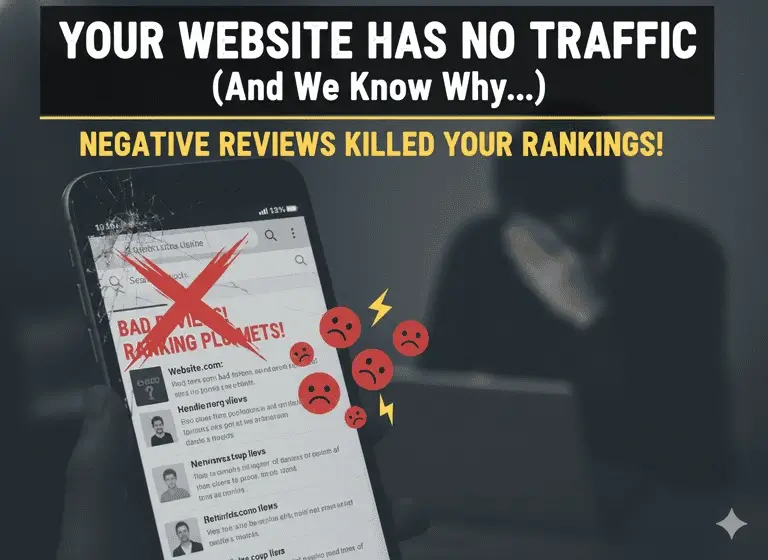
A note about negative reviews and their impact on rankings: a small number of genuine negative reviews among many positives has minimal direct ranking impact. The primary cost is in conversion. A professional, solution-focused response to a negative review consistently earns more trust from prospective customers than the original negative review costs.
Handling Fake and Incentivized Reviews
If You Suspect a Fake Negative Review
Check whether the reviewer has reviewed other businesses. Check if the review describes a service you do not offer or a date when you were closed. Flag the review through your GBP dashboard using “Conflicts of interest.” Document your evidence. Do not publicly accuse the reviewer without certainty.
The Rule on Incentivized Reviews
Offering any discount, gift, or reward in exchange for a Google review violates Google’s policies. Incentivized reviews risk removal of all your reviews and potential listing suspension. Build genuine reviews through excellent service and a consistent, ethical ask. There is no shortcut that does not carry disproportionate risk.
For context on how reviews connect to your full GBP optimization, read our guide on how to optimize your Google Business Profile.
Frequently Asked Questions
How many reviews do I need to rank in the Local 3-Pack?
Search your target keyword and count the reviews of the top three Local Pack businesses. That is your market-specific benchmark. There is no universal answer. In low-competition markets, 20 to 30 reviews may be sufficient. In competitive urban markets, 100 or more is often the threshold for serious top-3 contention.
Do reviews on other platforms like Trustpilot affect my Google ranking?
Not directly. Only Google reviews on your GBP directly influence Local Pack rankings. Reviews on other platforms may build brand authority and Prominence indirectly, but for Local Pack rankings specifically, only Google reviews count.
What if I ask for reviews and get a sudden spike? Does that hurt me?
A natural pattern of reviews arriving consistently over time appears organic. A pattern of 50 reviews in 48 hours triggers Google’s spam detection. Build reviews consistently and organically. Steady monthly velocity is both safer and more effective than any burst approach.
Key Takeaways
- Google reviews directly drive up to 17% of local pack ranking weight through 4 specific measurable signals
- Review velocity (consistent monthly arrivals) is the most important and most neglected signal in 2026
- 73% of consumers trust only reviews from the last 30 days: review generation must be a permanent operational function, not a campaign
- Ask customers to describe their specific experience in detail to generate keyword-relevant content ethically
- Respond to every review individually within 48 hours: 54% of reviews receive no response, making consistent replies a direct competitive advantage
- Map your peak satisfaction moment and train every customer-facing team member to make the ask at that moment
For the complete local SEO strategy connecting reviews to every other ranking signal, return to our comprehensive local SEO guide.