Your Website Traffic Is Down Because AI Is Answering Searches Before Your Site Can? Fix it in 2026

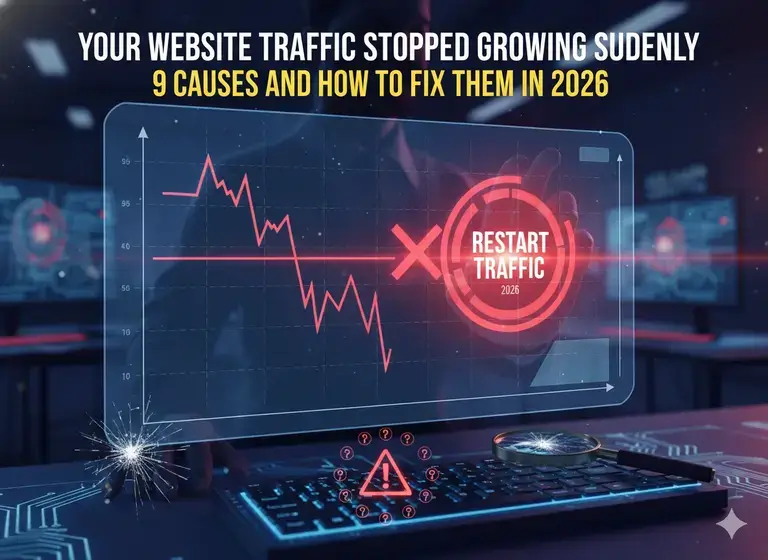
Your rankings have not changed. Your content has not changed. Your technical setup is fine. But your website traffic is down and clicks are declining. You open Google Search Console and see impressions holding but clicks falling month after month.
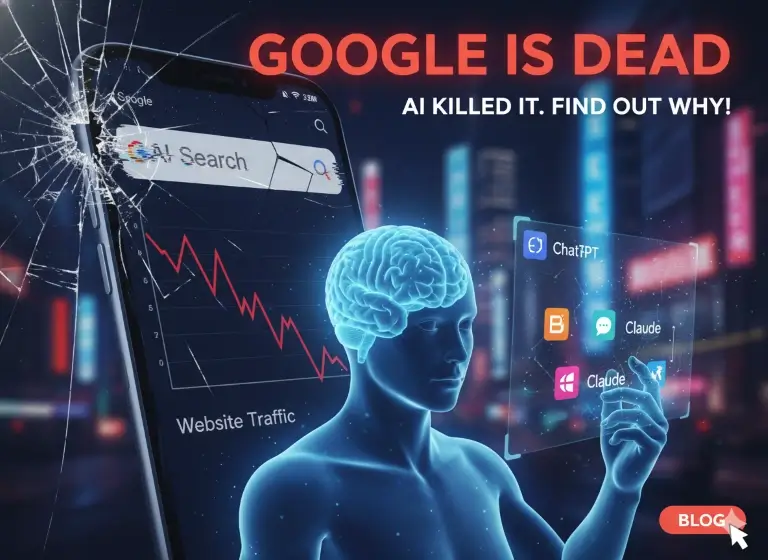
This is the new traffic problem. And it is different from every traffic problem that came before it. Your website traffic is down because AI is answering searches before your site can get a click.
Google AI Overviews are now answering users’ questions directly inside the search results page. The user sees the answer. They do not click. Your position-one ranking still exists. It is sitting below an AI-generated summary that already satisfied the query before the user scrolled to you.
This is not a temporary fluctuation. Understanding it correctly is the foundation of every practical response.
Table of Contents
Why Your Website Traffic Is Down: Understanding AI Answering Searches
The scale of what has changed in search is important to understand before deciding how to respond.
By early 2026, approximately 60% of all Google searches end without a click to any website, according to multiple research sources including Semrush click-stream analysis and Bain and Company survey data. Google AI Overviews now appear in a significant proportion of queries across many categories, and when an AI Overview appears above organic results, the first organic position earns dramatically fewer clicks than it would without the Overview present.
This is why your website traffic is down even while your rankings remain stable. AI is answering the searches before users reach your organic result. The query is being satisfied on the search results page itself.
For specific content types, the impact has been severe. Simple how-to queries, definition queries, factual lookups, and basic list content are now largely answered within AI Overviews. Users receive the answer and leave without clicking.
For other content types, the impact is minimal. Transactional queries where users need to take an action, complex comparison queries requiring personal context, local service queries, and content requiring specific first-hand experience all retain most of their click value. Understanding this distinction is the foundation of every practical response.
Is Your Traffic Drop From AI Overviews or Something Else?
Before attributing your traffic decline to AI answering searches, confirm this is the actual cause. A technical issue or algorithm update can produce similar symptoms.
Signs that AI Overviews are causing your website traffic to be down:
In Google Search Console, your impressions are stable or declining slowly, but your clicks are dropping faster. Your average position is roughly unchanged. The keywords losing click-through rate are predominantly informational queries. The decline started or accelerated from mid-2024 onward, which is when AI Overviews rolled out at scale to all users.
Signs that something else is causing your traffic to drop:
Impressions dropped significantly alongside clicks. Specific pages lost rankings entirely. Search Console shows coverage or indexing problems. The decline aligns precisely with a confirmed algorithm update rollout date from the Google Search Status Dashboard.
The clearest diagnostic:
Filter your queries in Search Console and look at click-through rate trends over the past 18 months for informational queries specifically. If click-through rate has been steadily declining while impressions held roughly stable, AI Overviews are absorbing the clicks your content was previously earning.
Content Losing Traffic to AI Answering Searches
Knowing which content types are most affected helps you prioritise your response.
High-risk content types when AI is answering searches:
General how-to guides on well-documented topics. AI Overviews synthesise these answers completely and often more efficiently than any single article can.
Definition and explanation content. “What is keyword research” or “what is content marketing” are fully answerable within an AI summary. The user has no reason to click.
Factual lookups with single clear answers. “Best time to post on Instagram” or “average ecommerce conversion rate” are delivered as direct answers without requiring a website visit.
Basic list content. “Top project management tools” or “best CRM software” are easily synthesised into a quick summary that satisfies most users’ informational need without clicking.
Content That Is Holding Despite AI Answering Searches
Content with strong protection from AI search disruption:
Transactional and commercial intent content. When someone searches “hire an SEO consultant for my business” or “book a restaurant for a birthday dinner,” they need to take an action, not just receive an answer. AI cannot hire or book for them. These queries still consistently generate clicks.
Complex decision-support content. Queries like “which CRM should a five-person sales team focused on outbound use” cannot be fully answered without knowing the specific team’s situation, budget, and existing integrations. Genuinely contextualised recommendation content remains click-worthy.
First-hand experience content. Case studies, specific outcome reports, practitioner observations, and content that can only have been written by someone who actually did the thing are not synthesisable from existing public sources. They remain in genuine demand.
Local and specific service content. Searches with local or specific service intent continue generating clicks because the user needs to find a specific provider, not just general information about a service type.
Fix 1: Shift Toward Commercial and Decision-Stage Content
The most direct response to website traffic down from AI answering searches is shifting your content mix toward content types that still generate clicks.
Build more content serving people in the decision-making stage:
“X versus Y: which is right for your specific situation and why.”
“How to choose a [service type] provider: what to look for and what questions to ask.”
“What [your service] actually costs and what drives the price up or down.”
“What working with a [professional type] looks like from the first call to the final deliverable.”
These articles attract people who have already completed their informational research and are now actively choosing. They convert at dramatically higher rates than informational content, and they are the queries AI Overviews are least equipped to fully satisfy.
Fix 2: Make Your Content Genuinely Unsummarisable
AI Overviews synthesise information that already exists in multiple sources. Content containing genuinely original information, specific first-hand experience, or insights that do not exist elsewhere cannot be accurately summarised by AI.
What unsummarisable content includes:
A specific client example with real granular details that reveals something instructive about how a situation actually unfolded. Not a generic case study. A real one with enough specifics to be meaningful.
An observation from direct practice that contradicts or adds nuance to the consensus view. Something you know from doing the work that most articles about the topic do not acknowledge because the authors have not done it.
Original data you gathered, even small-scale, explicitly framed as such.
A direct, specific position on a debated question in your field based on what you have personally seen.
Fix 3: Optimise for Inclusion in AI Overviews Themselves
Being cited or featured within Google’s AI Overviews provides brand exposure even without a direct click. It is worth pursuing alongside traditional ranking work.
What the content structure needs to achieve inclusion:
Lead every major section with a direct answer in 40 to 60 words. AI retrieval systems identify answer-like structures: concise paragraphs directly addressing a question immediately after it is posed. Structure your content so every major section begins with this direct answer before expanding into supporting detail.
Use clear, declarative sentences without excessive hedging. AI systems favour content making explicit, unambiguous statements.
Implement FAQ schema markup to make the question-and-answer structure machine-readable and easier for AI systems to parse and extract.
Update content regularly with current information. AI Overviews favour recent data. An article with statistics from 2022 is less likely to be cited in an AI Overview than one updated in 2026.
Cite your sources with links to primary sources. Credible, well-cited content is more likely to be selected for inclusion in AI summaries.
Fix 4: Build Referral Traffic From AI Platforms Beyond Google
ChatGPT, Perplexity, Claude, and other AI platforms are becoming search entry points for a growing audience. Traffic from these platforms grew substantially in 2025 and continues to grow in 2026.
AI platform visitors convert well. They are typically further in their decision process, having already used AI for initial research, and they are clicking through to go deeper on a specific question.
What gets referenced by AI platforms:
Clear authorship with verifiable credentials. Content from identifiable experts with demonstrable backgrounds is referenced more reliably than anonymous or lightly attributed sources.
Well-cited data with links to primary sources. Factual accuracy is a quality signal for AI evaluation systems.
Structural clarity making content easily extractable. Clear headings, summary boxes, logical question-and-answer formatting.
Consistent factual accuracy across multiple topics. Sources that are consistently accurate get referenced more reliably over time.
Fix 5: Diversify Your Traffic Sources
If all your traffic comes from Google, AI Overviews and zero-click behaviour represent a concentration risk with no natural hedge.
Building audiences on additional channels creates traffic sources not subject to the same dynamics as Google organic search.
An email newsletter creates a direct line to your audience that no platform algorithm controls. A YouTube presence builds a search audience on a different platform with its own discovery system. A LinkedIn following connects you to a professional audience actively seeking expert perspectives. Community presence in relevant forums builds genuine relationships producing referral traffic independent of search algorithm changes.
None of these replaces organic search. Each one reduces your dependence on a single channel that is in structural transition.
Fix 6: Target Queries That Still Generate Clicks
The clearest near-term protection against AI answering searches and reducing your traffic: target queries where the answer cannot be fully delivered in an AI summary.
Queries requiring personal context: “what should I specifically do in this situation.”
Queries requiring current local information: “nearest provider of X open now.”
Queries requiring a specific action: “book,” “hire,” “buy,” “get a quote.”
Queries requiring depth beyond a paragraph: complex how-to processes where missing one step breaks the outcome.
Queries where source authority matters to the user: financial decisions, health questions, legal situations where the credibility of the source is as important as the information itself.
Building your content strategy around these query types insulates you from AI Overview disruption far more than any single optimisation tactic.
Fix 7: Reframe Your Success Metrics for 2026
In a world where AI Overviews absorb a portion of clicks, raw click volume is becoming a less complete measure of search visibility and business impact.
More useful metrics when website traffic is down due to AI answering searches:
Branded search volume. When your content appears in AI Overviews, some users who saw your brand name without clicking will search for you by name later. Rising branded search volume indicates growing brand awareness from search visibility even when direct clicks are not captured.
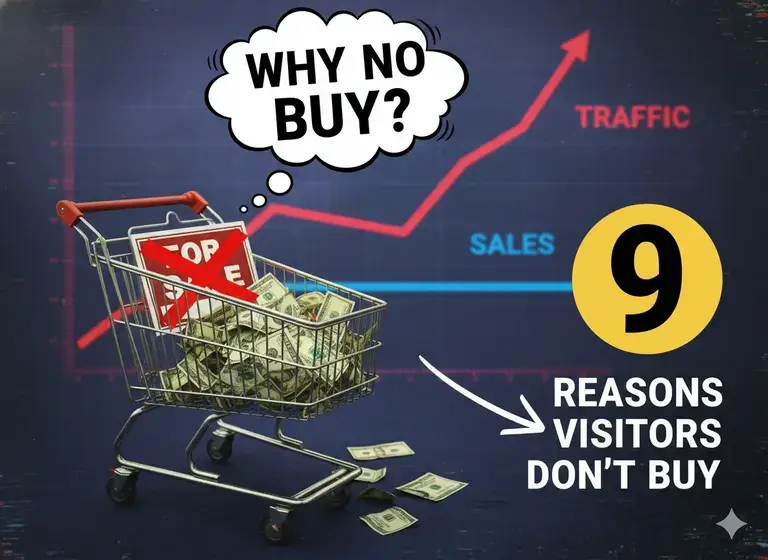
Conversion rate per organic click. Fewer clicks with the same conversion rate means the clicks arriving are from higher-intent users. Track revenue per organic visit, not just total organic visit volume.
AI platform referrals. Set up tracking for referrals from ChatGPT, Perplexity, and other AI platforms in your analytics. This traffic source is small but growing and often arrives at high intent.
Direct traffic trends. Brand awareness built through AI Overview exposure eventually translates into users visiting your site directly. Rising direct traffic is a lagging indicator of search visibility that raw click metrics do not capture.
Frequently Asked Questions
Why is my website traffic down even though my Google rankings have not changed?
This is the specific signature of AI Overview impact. Your rankings are stable but AI-generated summaries now appear above your result for informational queries and answer the user’s question before they scroll to click your link. Impressions staying flat while clicks decline over the same period confirms this pattern. Check the Performance report in Search Console filtered to informational queries specifically.
Is SEO still worth investing in if AI is causing my website traffic to be down?
Yes. Organic search still accounts for the largest single traffic source for most websites despite the zero-click shift. The strategy required has evolved, but the channel is not obsolete. Content targeting decision-stage queries, demonstrating genuine expertise, and earning external references continues to produce organic traffic in 2026.
How can I get my content included in Google’s AI Overviews to recover lost traffic?
Structure every major section with a concise 40 to 60 word direct answer at the beginning. Use clear declarative sentences. Implement FAQ schema and Article schema. Keep content factually current and cite your sources. Make your authorship and expertise clearly identifiable. No guaranteed method exists, but these practices meaningfully increase the probability of inclusion.
Should I abandon informational content entirely since AI is answering those searches?
No. Informational content builds topical authority, attracts users early in their decision process, and supports ranking for associated commercial queries. The goal is to add more commercial-stage content alongside your informational content, not to replace it. The strongest content strategy includes both: informational content that builds authority and trust, and commercial content that captures decision-ready visitors.
What content is most protected from AI search traffic losses?
Content requiring first-hand experience, personal context, or transactional action. Case studies, original research, specific practitioner observations, comparison content for specific buying decisions, and local service content all retain more click value in an AI search environment than generic informational content does.
Will AI platform traffic eventually replace the Google traffic I am losing?
Not entirely and not quickly. AI platform referrals are growing from a small base. They are worth optimising for, but they are unlikely to fully offset Google click losses for most sites in 2026. The practical response is building a diversified traffic portfolio rather than betting on a single replacement source.
My website traffic has been down for 6 months due to AI. Is there a quick fix?
There is no single quick fix, but the fastest improvements come from: shifting existing commercial-intent pages to be more specific and decision-supporting, adding FAQ schema to your most important pages, and simplifying your homepage CTA to capture the higher-intent clicks that are still arriving. These can be done within a week and typically improve conversion rates on the traffic you are still receiving.
The Adaptation Required
The shift to AI-mediated search is real and ongoing. The websites that adapt are not the ones fighting it or ignoring it. They are the ones understanding which content types still earn clicks, making their content genuinely unsummarisable through first-hand expertise, and building audience relationships that do not depend entirely on one traffic source.
This does not require abandoning what has worked in SEO. It requires building on it with a clearer understanding of which content serves which purpose in the current environment.
If you want to audit your specific content mix against the AI search landscape and identify where to redirect your effort:
That is work I do at ajitkumargupta.com
You can also read my content strategy guide or explore my SEO services to understand the full scope of what this adaptation involves.