

Your traffic dropped after a Google Helpful Content Update and the explanations you have read so far have not told you what you actually need to know.
Most articles about traffic dropped after Google helpful content update impacts tell you to “write better content,” which is too vague to act on, or they explain classifier systems in technical language that does not connect to what you should change this week. This guide does something different. It confirms whether the HCU is actually what affected your site, explains precisely what it targets, and gives you a real recovery process.
Table of Contents
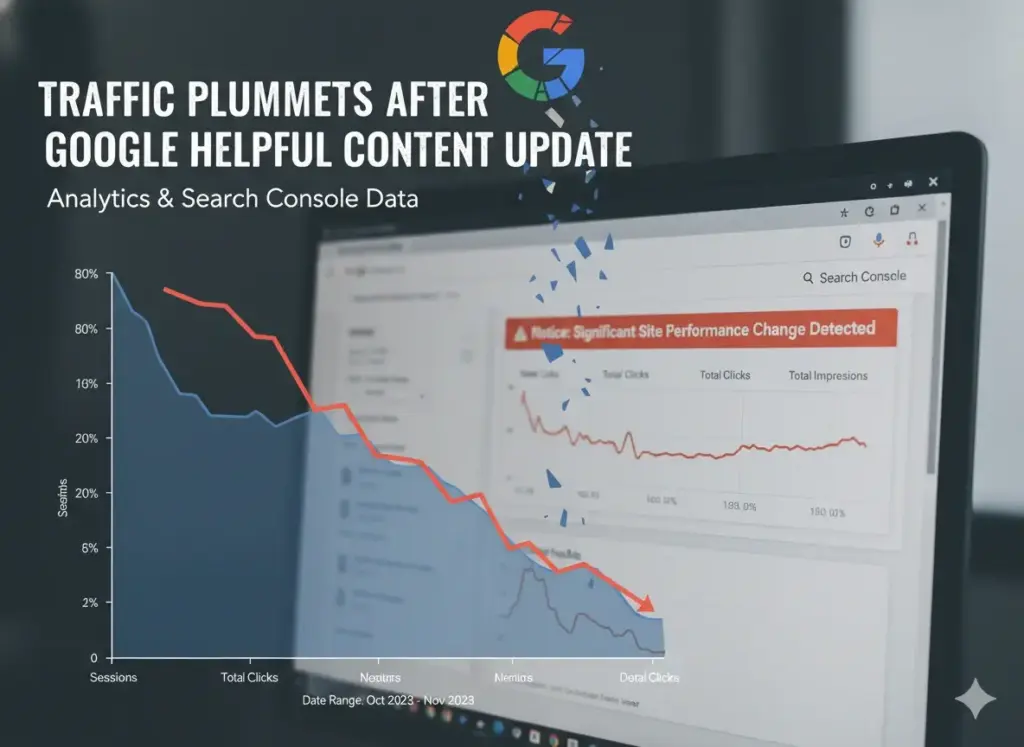
Is Your Traffic Drop Actually From the Helpful Content Update?
Confirm this before doing any recovery work. HCU recovery requires different actions from core update recovery, and mixing them up wastes months.
Signs that suggest HCU caused your traffic to drop:
Your traffic drop was broad, affecting many different pages across different topic areas at once. The decline was gradual over several weeks rather than sudden within 24 hours. A significant portion of your site’s content was produced primarily to rank for keywords rather than to help readers accomplish something specific. Your engagement metrics are poor: users leave pages quickly, do not click deeper, and rarely return.
Signs that suggest something else caused the drop:
The drop was sudden and isolated to specific pages or keyword clusters. The drop date aligns precisely with a confirmed core update rollout. You can identify specific technical issues in Google Search Console. A manual action notice appears in Search Console.
One important clarification: Since late 2023, Google has integrated the Helpful Content system into its core update infrastructure. A recent drop may reflect core update evaluation that includes HCU signals rather than a standalone HCU rollout. The recovery approach is similar regardless, but knowing this prevents waiting for a separate HCU fix that will not come as a separate event.
Why Your Traffic Dropped After a Google Helpful Content Update
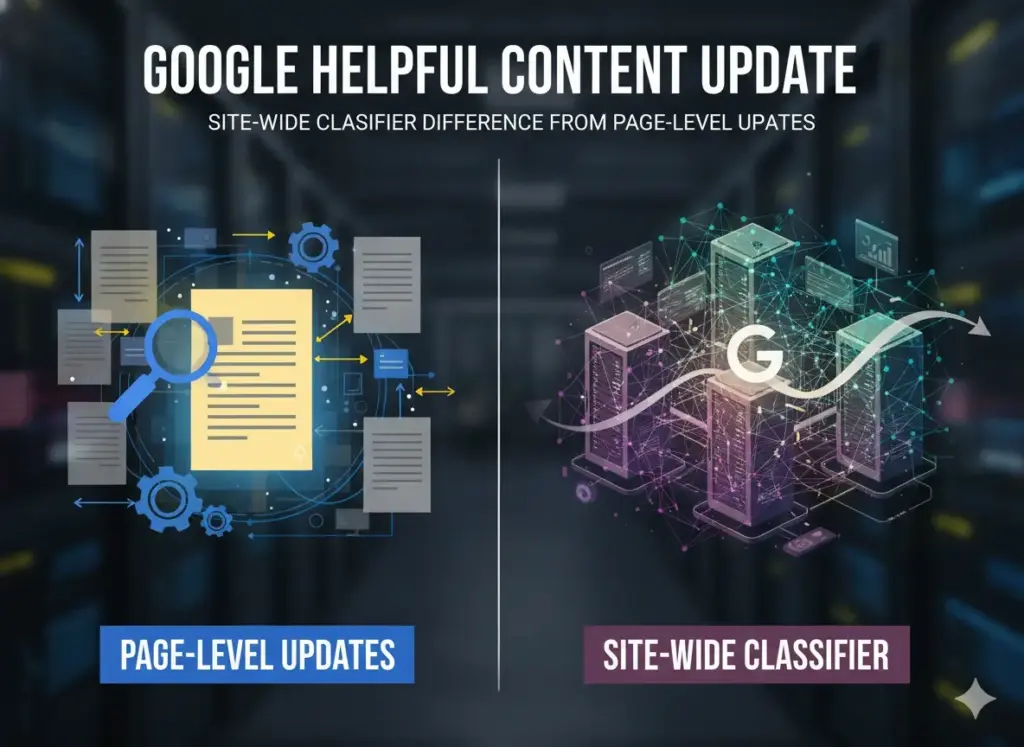
The Helpful Content Update does not evaluate pages in isolation. This is the most important distinction to understand before you change anything.
Every major Google update before the HCU primarily evaluated pages individually. A high-quality page could rank well even if many other pages on the same domain were mediocre. Individual page strength was the primary ranking signal.
The HCU changed this. It applies a site-wide quality classifier.
According to Google’s helpful content documentation, the system assesses whether a site’s content overall was created primarily to help people or primarily to rank in search results. If Google determines that a significant portion of your site’s content is search-first rather than people-first, that assessment can suppress rankings across your entire domain, including pages that are individually well-written and genuinely useful.
This has one major practical implication: you cannot fix an HCU impact by improving a few of your best pages. You must address the overall ratio of genuinely helpful content to search-engine-oriented content across your entire site.
What Helpful Content Actually Means to Google in 2026
Google publishes specific questions for evaluating helpful content. Here is what those questions mean in practical terms.
Was this written for a person, not a search engine? Content written for a person has a coherent purpose beyond keyword coverage. It exists because the author genuinely has something useful to say. Content written for search engines covers every semantically related keyword mechanically and lacks any authentic voice or perspective that reflects genuine investment in the reader.
Does this reflect first-hand knowledge? The word Experience was added to Google’s E-E-A-T framework specifically because of the HCU. Google looks for signals that the person writing about a topic has actually done the thing, not just researched it. Direct experience produces specific details, accurate nuances, and coverage of aspects that only someone who has done the work would know to address.
Does this fully satisfy what the reader came to find? A page that answers the surface question but leaves the reader needing to visit another site for the complete answer is not fully satisfying the search intent. The HCU system evaluates behavioural signals: do users leave quickly? Do they immediately return to search results and click other results? That behaviour indicates the content failed to deliver what was needed.
The Seven Content Patterns HCU Targets Most Aggressively
Based on patterns observed across sites significantly affected by HCU, these are the content types most vulnerable.
Pattern 1: Templated content at volume. Large volumes of content produced using a repeatable template, AI generation without expert review, or outsourced writers with no subject matter expertise. Volume without genuine helpfulness is the core of what HCU was built to reduce.
Pattern 2: Content that aggregates without adding anything original. Articles assembling information from existing sources without adding a unique perspective, original data, or direct experience. There is no reason for Google to rank the aggregator above the originals.
Pattern 3: Surface coverage driven by keyword volume. An article covering a complex topic at the surface level because the keyword had traffic, not because a surface treatment was genuinely sufficient. These pages earn clicks but consistently fail users.
Pattern 4: Off-topic content chasing search demand. A cooking site publishing cryptocurrency articles. A personal finance blog writing fitness content. The topical mismatch signals content produced for search opportunity rather than for a genuine audience.
Pattern 5: Headlines that overpromise. Titles making strong promises the article body does not fulfill. High click-through rate combined with high immediate exit rate is the behavioural signature HCU penalises most directly.
Pattern 6: Definition-only content. Pages answering “What is X?” with only a brief definition and nothing more. These pages existed to capture informational queries and provide no value beyond what an AI summary can deliver in 2026.
Pattern 7: Anonymous content from unidentifiable sources. Articles with no author attribution, no expertise signals, no credentials relevant to the topic. In 2026, content from an unidentifiable source carries significantly reduced trust in Google’s quality evaluation.


How to Audit Your Own Site for HCU Vulnerability
Step 1: Categorise your content by primary purpose.
Go through your most important 50 pages. For each one, answer honestly: was this written primarily to help a specific reader accomplish something, or primarily to rank for a keyword? The ratio of reader-first to search-engine-first content reflects your HCU risk level. A site that is 80% reader-first has low vulnerability. A site that is 60% search-engine-first has significant exposure.
Step 2: Check engagement metrics at the page level.
In your analytics platform, look at average engagement time and exit rates by page. Pages where users spend less than 30 seconds and immediately leave are failing the helpfulness test with real visitors. These are your highest-priority recovery targets regardless of their current keyword rankings.
Step 3: Assess topical coherence.
Does your site’s content cluster around a clear topic area reflecting genuine expertise? Or does it spread across many unrelated topics in pursuit of keyword opportunities? The HCU classifier penalises topical incoherence as a signal of search-first publishing.
Step 4: Count pages with no author expertise signals.
Find all pages without author attribution, credentials relevant to the topic, or experience-based content. These are vulnerability points the classifier identifies as low-trust sources.
The Recovery Process: What It Actually Requires
Recovery from an HCU impact is site-level work. This is the fundamental difference from most other types of SEO recovery, where improving individual pages is sufficient.
Remove or substantially improve content that fails the helpfulness test.
For thin, templated, or purely search-oriented content: improve it substantially with real expertise and direct experience, or remove it with proper 301 redirects to the most relevant remaining content.
The decision rule: if a page cannot be made genuinely helpful without rebuilding it from scratch with real subject matter expertise, remove it. Leaving unhelpful content on your site continues suppressing your site-wide quality signals even if individual pages look acceptable in isolation.
Add genuine first-hand experience to every piece of content you keep.
For every piece of content you retain, add a section that could only have been written by someone with direct contact with the subject. A specific example from real work. An observation from doing the thing that most articles miss because the authors have not done it. A detail requiring direct experience to know.
Build topical coherence going forward.
Stop publishing content outside your genuine areas of expertise. Identify two or three subjects where your site has authentic knowledge and concentrate all future content production there. This builds the topical authority signals the HCU classifier recognises as genuine expertise over time.
Consolidate overlapping content.
If you have multiple pages covering similar aspects of the same topic with minimal real differentiation, merge them into one comprehensive resource. Redirect the weaker versions. This concentrates quality signals rather than diluting them across multiple thin pages.
Apply a stricter publishing standard from now on.
Before publishing any new content, ask one question: would someone read this and leave measurably better equipped than before they arrived? If the answer is not clearly yes, do not publish it.

How Long HCU Recovery Takes
HCU recovery is genuinely slower than core update recovery. The site-wide quality classifier takes more time to re-evaluate a site after improvements than page-level ranking changes.
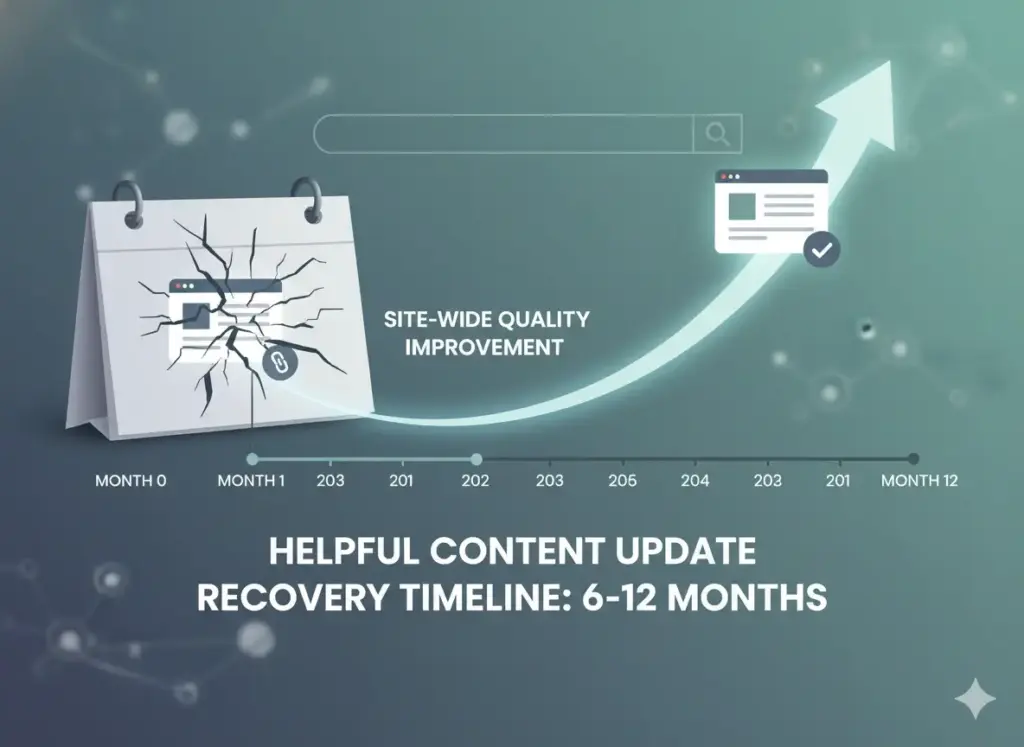
Months 1 to 2: Complete the content audit. Remove or substantially improve failing content. Stop publishing anything that fails the helpfulness test. Add author credentials and first-hand experience to priority pages.
Months 2 to 4: Early movement in Search Console impressions for substantially improved pages. Traffic recovery is modest at this stage. Google is beginning to reassess but has not fully updated its domain-level evaluation.
Months 4 to 8: Genuine traffic recovery if improvements have been consistent and substantive. The leading indicator to watch: engagement metrics improving on your upgraded pages before rankings visibly return.
Months 8 to 12: Full recovery for sites that made genuine improvements. Sites where the core business model relied on content patterns HCU targets may require essentially rebuilding the content strategy from the foundation.
One honest note: some sites affected by HCU have not recovered even after significant effort. This typically happens when the site was built primarily on the content patterns HCU targets and rebuilding requires starting from a different content strategy entirely.
Frequently Asked Questions
What is the Google Helpful Content Update and how is it different from core updates?
The Helpful Content Update introduced a site-wide quality classifier that assesses whether a site’s content was created primarily for people or primarily for search engines. Unlike core updates that evaluate pages more independently, the HCU classifier suppresses site-wide rankings if a significant portion of content is search-first. Since late 2023, the HCU system has been integrated into core update infrastructure.
Can I recover after my traffic dropped from the Helpful Content Update?
Yes, but recovery requires site-level content quality improvement, not page-level fixes. Sites that have removed or substantially improved thin content, added first-hand experience signals, built topical coherence, and established clear author expertise do recover. The realistic timeline is six to twelve months of consistent work.
Does removing thin content help after traffic dropped from HCU?
It helps, provided removed pages are properly redirected to the most relevant existing content. Leaving unhelpful content in place continues depressing site-wide quality signals. Strategic removal with redirects is better than deletion without them.
Will AI-generated content cause HCU problems?
AI-generated content is not automatically penalised. What is penalised is content produced primarily to rank without genuine expertise, depth, or helpfulness, regardless of how it was produced. Well-edited AI content reflecting genuine expertise and serving readers is not a target. Mass-produced AI content with no expert review is exactly what HCU targets.
How is HCU recovery different from core update recovery?
Core update recovery is primarily page-level: identify declining pages and improve those specifically. HCU recovery is site-level: you must address the overall ratio of helpful to search-oriented content across your entire domain. Improving individual pages without addressing the site-wide quality ratio has limited effect on HCU impacts.
My traffic dropped after the HCU months ago. Is it too late to recover?
It is not too late. Recovery is possible regardless of how long the traffic has been suppressed, provided the improvements are genuine and sustained. Sites that delayed action simply need to commit to a longer improvement period before seeing results.
What is the one thing that helps most after traffic dropped from the Helpful Content Update?
Adding genuine first-hand experience and demonstrable expertise to your content. Content that reflects direct contact with the subject, specific real examples, and insights that only a practitioner would provide is the strongest signal against HCU suppression. It is also the hardest signal to replicate at scale, making it a durable competitive advantage once established.
How do I know if my content is people-first or search-engine-first?
Ask this question for each piece of content: if search engines did not exist and this content could not be found through search, would I still have published it? If the answer is yes because your audience needs it and you have something genuine to say, it is people-first. If the answer is no, it is search-engine-first.
The Question at the Centre of This Update
The Helpful Content Update is not asking whether your content is well-written. It is asking whether your content exists because you had something genuinely useful to say, or because a keyword tool showed the topic had traffic.
That is a harder question to answer honestly than most SEO questions. But it is the right question. Answering it honestly is the beginning of recovery.
If you want a direct assessment of how your site holds up against the helpfulness standard and a specific list of what needs to change first:
Start here at ajitkumargupta.com
You can also read my content strategy guide or explore my SEO services to see how I work through this with clients.