
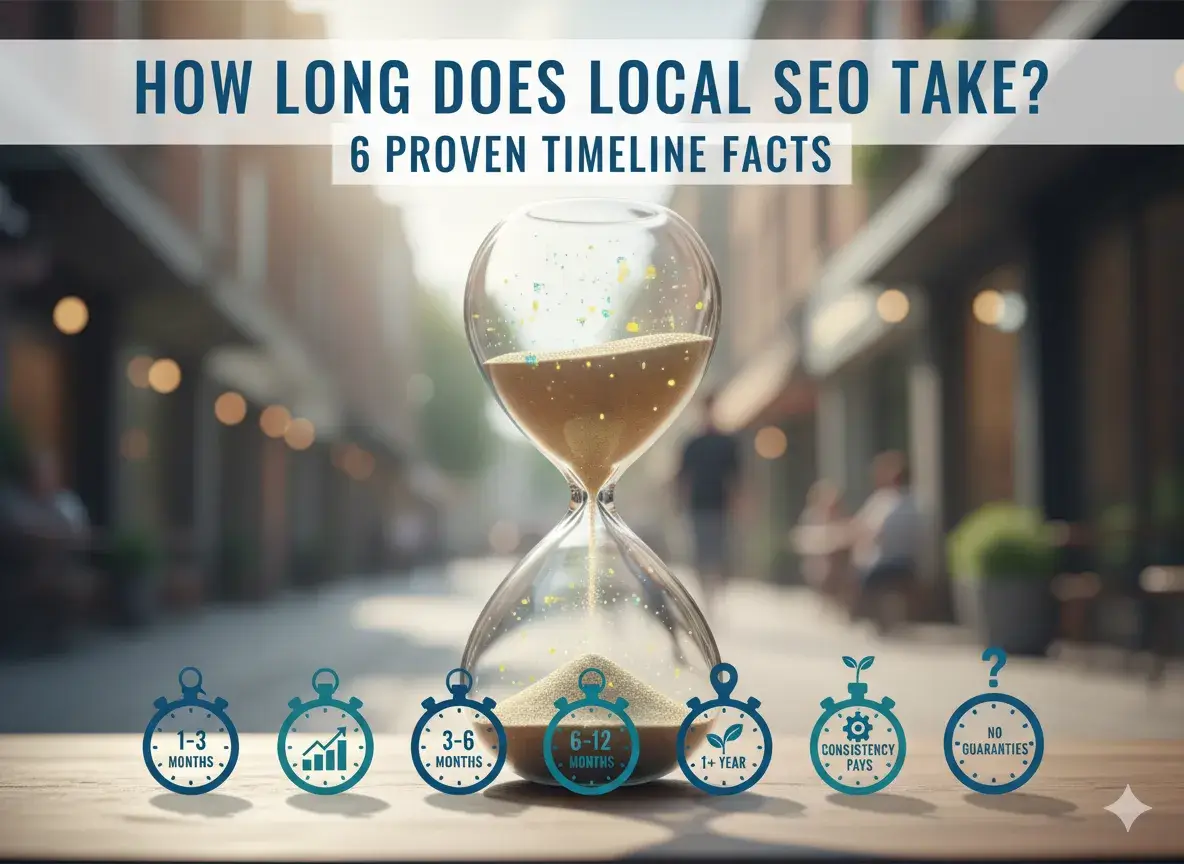
How long does local SEO take is the first question most business owners ask before committing to it. It deserves a specific, honest answer, not the vague “it depends” most guides provide.
Most businesses see their first Local Pack movement within 4 to 12 weeks of completing foundational optimizations. Consistent top-3 positions in competitive markets typically take 3 to 6 months. Low-competition areas can see meaningful visibility in 2 to 4 weeks.
This guide explains the variables that control where on that range a specific business lands, and what can be done to move toward the faster end of it.
Table of Contents
How Long Does Local SEO Take? The Direct Answer
Initial Local Pack movement typically appears within 4 to 12 weeks of completing foundational optimizations including GBP optimization with the correct primary category, Tier 1 citations, and the start of consistent review generation. Consistent top-3 positions in moderately competitive markets take 3 to 4 months. Highly competitive urban markets typically require 4 to 8 months. The five variables controlling your timeline are market competition, your starting position, review velocity, citation propagation timing, and website signal completeness.
Why Local SEO Takes the Time It Does
Before the specific facts, it helps to understand the underlying mechanism.
Local rankings are not a switch you flip. They are the output of multiple signals that Google aggregates over time. Your primary category affects ranking eligibility immediately. Citations take 4 to 8 weeks to propagate through aggregator networks. Reviews build a velocity signal that compounds over months. Backlinks accrue domain authority gradually.
Google also updates local rankings continuously, not in monthly batch updates. Changes you make today affect how Google reads your signals next time it crawls and indexes your profile, which typically happens within 1 to 3 weeks for high-priority platforms.
You are probably thinking: “I want faster results. Can I speed this up?”
Yes, within specific constraints. The fastest controllable accelerators are: correcting a wrong primary category (produces movement in 2 to 4 weeks), starting review generation immediately (compounds from week one), and submitting to data aggregators on day one rather than after completing other tasks (starts the 4 to 8 week propagation clock immediately). None of these shortcuts skip the process. They just start each component earlier.
6 Proven Facts About Local SEO Timelines
Fact 1: Market Competition Determines Your Timeline More Than Anything Else
Two businesses doing identical optimization work see dramatically different timelines based on one variable: their competitive landscape.
Before making any timeline estimates, search your primary keyword in your target city. Look at the top three Local Pack results.
- How many reviews do they have? Count them.
- How recently were the most recent reviews posted?
- How complete and active do their profiles appear?
- How strong do their websites look?
If top businesses have 400 reviews with fresh weekly arrivals and active profiles, you are in a high-competition market. Expect 4 to 8 months for consistent top-3 positioning.
If they have 15 reviews from four months ago and sparse profiles, you are in a low-competition market. Expect 3 to 8 weeks for significant movement.
This 20-minute assessment tells you more about your realistic timeline than any general estimate.
Fact 2: Review Velocity Is the Fastest Controllable Accelerator
Of everything you can control, starting your review system immediately produces the fastest visible ranking improvement.
73% of consumers only trust reviews from the last 30 days. Google’s algorithm weights recency directly. A business generating four reviews per month from day one reaches the competitive review threshold faster than any other approach.
The critical insight: starting today versus starting in six weeks creates a gap that does not close easily. A business that begins generating four reviews per month in week one has 24 reviews after six months. One that delays starting by six weeks has 20. That four-review gap carries a velocity signal disadvantage that persists.
Do not wait until your profile is “fully optimized” before asking for reviews. Start your review request system on the same day you complete your primary category selection.
Fact 3: Data Aggregator Propagation Takes 4 to 8 Weeks and Cannot Be Rushed
When you submit your business data to data aggregators (Neustar Localeze, Data Axle, Foursquare), their distribution to downstream directories takes 4 to 8 weeks. This timeline is determined by their own crawl schedules. Nothing you do accelerates it.
The implication: submit to aggregators on day one of your local SEO work. The propagation clock starts the day you submit. A business that submits in week one has full citation coverage by weeks 5 to 9. One that submits in week 8 does not reach full coverage until weeks 12 to 16.
You save 6 to 8 weeks from your total timeline simply by starting citation work immediately rather than after finishing other tasks.
Fact 4: A Wrong Primary Category Stalls Everything
If your primary GBP category is wrong or too broad, you are ineligible for your most valuable search queries regardless of how strong every other signal is. No amount of reviews, citations, or website work compensates for an eligibility problem.
Category corrections produce ranking movement within 2 to 4 weeks in most markets. This makes it the single fastest improvement available to businesses with a category mismatch.
If you have been optimizing for more than 10 weeks without visible Local Pack movement, checking your primary category against the top three ranked competitors is the first diagnostic step, not the last.
Fact 5: Missing LocalBusiness Schema Creates a Ceiling
Websites without LocalBusiness schema markup leave ranking signals unclaimed. Google infers your business data from unstructured page text rather than reading it from a dedicated machine-readable source.
Adding schema is a 30-minute task (or a settings toggle in Rank Math or Yoast). It can produce ranking improvement within 2 to 4 weeks. For businesses that have completed GBP optimization and citation building but not added schema, this is often the remaining bottleneck.
Fact 6: Rankings Require Ongoing Maintenance to Hold
Reaching the top 3 is the beginning of an ongoing competitive commitment, not the end of a project.
Competitors who maintain their profiles accumulate review velocity, photo recency, and post activity that you are not building if your profile goes dormant. A business that reaches the top 3 and then stops monthly maintenance typically loses those positions gradually over 2 to 4 months as competitors’ signals grow fresher.
The maintenance required is modest: approximately 2 to 3 hours per month. Understanding this from the start sets the right expectation and prevents the mistake of treating local SEO as a project with a defined end date.
Your Month-by-Month Timeline
Here is what actually happens when you start from scratch and work through all the steps correctly.
Month 1: Foundation Building
What you do: Complete and verify your GBP with the correct primary category. Submit to all Tier 1 citations with identical NAP. Submit to data aggregators. Add LocalBusiness schema to your website. Optimize homepage title tag. Send your first review requests.
What you see: Your profile becomes eligible for Local Pack consideration. First citations index on Tier 1 platforms within 1 to 2 weeks. Aggregator propagation begins. First reviews may arrive.
What to expect: Minimal or no visible Local Pack appearances for your primary keyword in moderate to competitive markets. Rising profile impressions in GBP Insights as Google begins evaluating your profile. This is normal. The foundation is being established.
Month 2: Early Signals
What you do: Continue review generation at 3 to 5 per month. Publish weekly GBP Posts. Upload 3 to 5 new photos. Add Tier 3 industry-specific citations. Respond to every new review.
What you see: Profile appearances in the Local Finder (the extended list below the top three Pack results). Rising impression counts. For low-competition markets, first Local Pack appearances for long-tail and secondary queries.
Month 3: Building Momentum
What you do: Maintain all ongoing activities. Begin local backlink outreach: chamber of commerce, local news, supplier partner pages. Check your geo-grid ranking data for the first time.
What you see: For moderate-competition markets, Local Pack appearances for secondary queries. Rising GBP action counts (calls, direction requests, website visits). For low-competition markets, consistent top-3 positions for primary queries.
Months 4 to 5: Competitive Positioning
What you do: Maintain all ongoing activities. Use geo-grid data to focus effort on specific geographic areas where you are at positions 4 to 7.
What you see: In moderate markets, consistent Local Pack presence for primary keywords. In competitive urban markets, approaching top-5 to top-7 in the Local Finder for primary queries.
Month 6: Established Authority
What you do: Continue all maintenance. Review whether new service pages or location pages would extend your reach.
What you see: In competitive markets, approaching consistent top-3 positions. In moderate markets, an established top-3 position with strong monthly GBP action volumes. A structural ranking advantage that grows increasingly difficult for new competitors to displace quickly.
Why Is Local SEO Not Working Yet? 5 Diagnoses
If you have been optimizing for more than 12 weeks without visible movement, work through these five diagnoses in order.
Diagnosis 1: Wrong Primary Category
Check the primary categories of the top three ranked businesses. Is theirs more specific? A category correction produces movement within 2 to 4 weeks.
Diagnosis 2: Review Gap Too Large
Count competitor reviews and check their recency. If they average 100 reviews with weekly new arrivals and you have 20, that structural gap is your primary obstacle. Only sustained monthly generation closes it.
Diagnosis 3: NAP Inconsistencies
Run a citation audit with BrightLocal or Whitespark. Significant inconsistencies create conflicting identity signals that suppress rankings even when profile optimization is strong. For the cleanup process, read our guide on NAP consistency local SEO.
Diagnosis 4: Missing Schema
Validate your website with Google’s Rich Results Test. Missing LocalBusiness schema is a common ceiling-creating oversight.
Diagnosis 5: Proximity Gap
If every competitor is significantly closer to the geographic center of your target search area, compensate with stronger Prominence: more reviews, stronger website signals, and service pages specifically referencing the target area by name.
Use our local SEO checklist to confirm every foundational step is complete before assuming proximity is the primary cause.
Realistic Timeline by Scenario
| Scenario | First Pack Appearances | Consistent Top-3 |
|---|---|---|
| Low competition, complete foundations | 2 to 4 weeks | 4 to 8 weeks |
| Existing GBP, mainly needs review velocity | 4 to 10 weeks | 12 to 20 weeks |
| Moderate competition, starting from scratch | 8 to 16 weeks | 3 to 5 months |
| Competitive urban market | 10 to 18 weeks | 4 to 8 months |
| Severe NAP inconsistencies first | 6 to 10 weeks after cleanup | Varies post-cleanup |
Frequently Asked Questions
I have been doing local SEO for three months and see no movement. What should I do?
Work through the five diagnoses in order: category, review gap, NAP inconsistency, schema, proximity. The first gap you find is your primary problem. Do not try to fix all five simultaneously. Fix the most likely one, wait 4 to 6 weeks, and reassess. Most stalled timelines have one primary cause.
Can I speed things up by paying for a service?
The only legitimate acceleration is starting the right actions earlier, particularly review generation and aggregator submissions. Be skeptical of services promising guaranteed top-3 positions quickly. Techniques that produce fast artificial results typically result in listing suspension, which costs far more time to recover from than the normal optimization timeline.
Does local SEO ever stop needing maintenance?
No. Rankings require ongoing maintenance to hold. Competitors who maintain their profiles continuously accumulate the freshness signals you are not building if you stop. Monthly maintenance of 2 to 3 hours is a permanent operational commitment for any business that wants to hold Local Pack positions.
Key Takeaways
- Most businesses see initial movement in 4 to 12 weeks with foundational optimizations complete
- Competition is the most important timeline variable: audit your specific competitors before setting expectations
- Start review generation on day one: every week of delay is lost velocity that compounds into a timeline gap
- Submit to aggregators immediately: the 4 to 8 week propagation window starts the day you submit
- If results stall after 12 weeks, diagnose in order: category, review gap, NAP, schema, proximity
- Rankings require 2 to 3 hours of monthly maintenance permanently: stopping causes gradual decay within 4 to 8 weeks
For the complete step-by-step action plan, use our local SEO checklist. For the complete strategy, return to our comprehensive local SEO guide.